Understanding ppm Methane: What Sensitivity Numbers Actually Mean
When a methane detection system is described as having a sensitivity of 1 ppm, 5 ppm, or 10 ppm, the number can look straightforward. But what does it actually mean?
For anyone working around oil and gas facilities, methane detection, or gas sensing technology, understanding these numbers is important. A sensitivity specification is more than a number on a datasheet. It tells us something about the smallest concentration of methane a system is designed to identify, but it does not tell the whole story about how that measurement will behave in the field.
To understand what a sensitivity number means, it helps to start with the basic science behind ppm.
What does ppm actually mean?
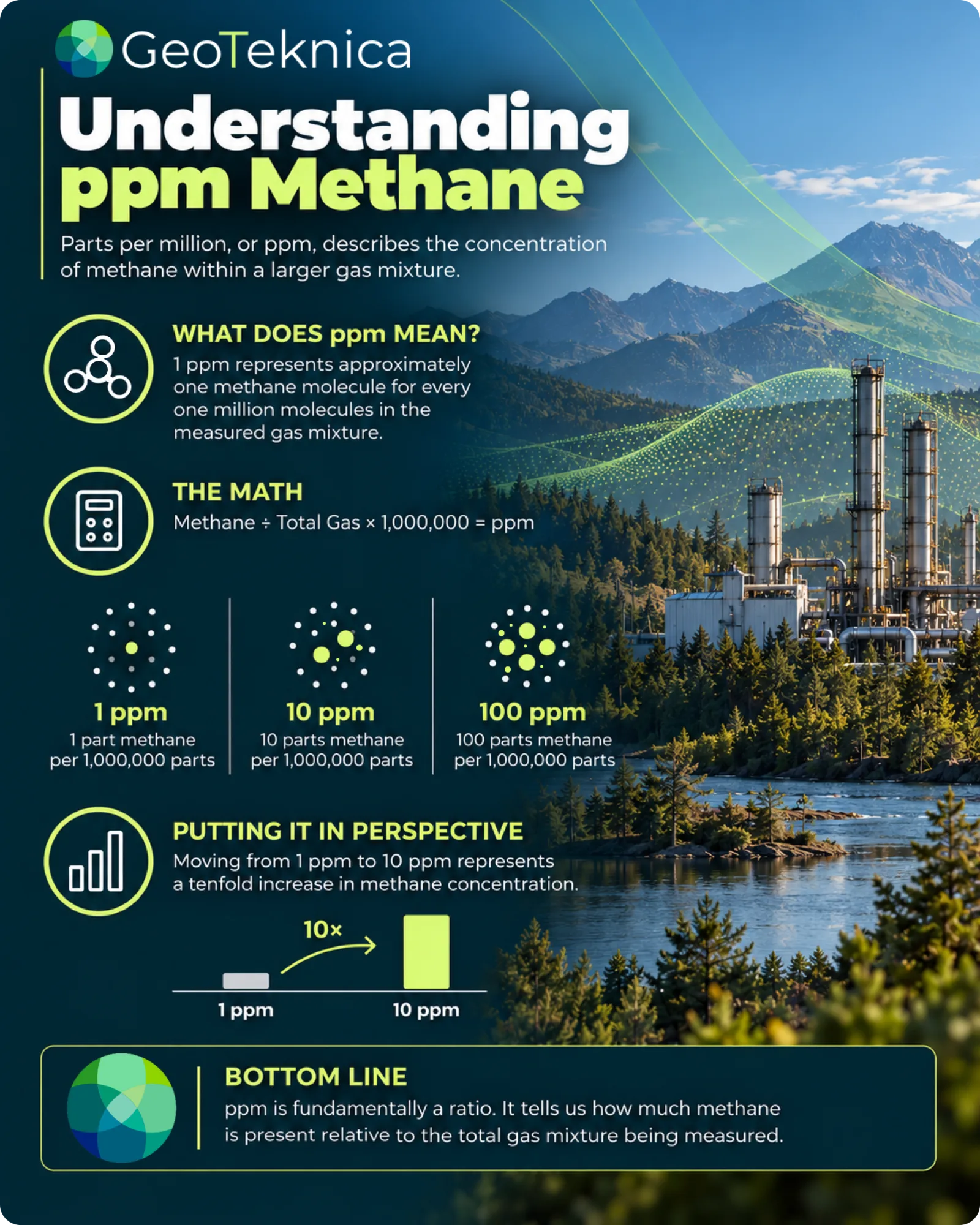
The abbreviation ppm means “parts per million.” It describes the proportion of one substance within a larger mixture.
In the context of gases, ppm methane generally describes the concentration of methane in a volume or amount of air. Mathematically, one part per million is equivalent to one part of a substance for every one million parts of the total mixture.
For example, a concentration of 1 ppm methane can be thought of as approximately one methane molecule for every one million molecules of the surrounding gas mixture when ppm is being used as a mole fraction. A concentration of 10 ppm methane would therefore represent approximately ten methane molecules for every million molecules of the mixture. It essential to remember that ppm is fundamentally a ratio.
NIST describes ppm as a relative value of 10⁻⁶, or one part in one million. The organization also notes that when ppm is used, the quantity being described needs to be clearly identified because the meaning depends on what is being measured. In gas measurement, ppm is commonly used to describe concentration by amount of substance, often expressed equivalently as micromoles per mole. (National Institute of Standards and Technology [NIST], 2019).
This gives us a useful mathematical relationship:
Concentration in ppm = amount of methane ÷ total amount of gas × 1,000,000
So, if methane represents 0.00001 of a gas mixture, the corresponding concentration is:
0.00001 × 1,000,000 = 10 ppm
The calculation itself is quite simple, the challenge comes from understanding what the number represents in a real environment.
Why ppm is useful for methane detection
Methane is present naturally in the atmosphere at very low concentrations. NIST reports a global average atmospheric methane concentration of approximately 1.92 ppm for 2023. (NIST, 2025). This should give you some useful perspective when looking at ppm measurements.
A methane sensor capable of detecting 1 ppm methane is operating at a very different level of sensitivity than a system designed to detect concentrations of 100 ppm methane. Both numbers describe methane concentration, but they represent very different measurement capabilities. The difference becomes particularly important when looking for methane emissions from industrial equipment.
A leak does not necessarily produce one consistent concentration of methane. Instead, methane released from equipment mixes with the surrounding atmosphere. The concentration close to the emission source may be relatively high, while the concentration farther away may become much lower. Meaning a system may encounter a plume containing hundreds or thousands of ppm methane near its source, while detecting only a few ppm methane farther away.
The number reported by a sensor is therefore not necessarily a direct indication of how much methane is being released. It is a measurement of the methane concentration at the point where the measurement is being made.
Concentration is not the same as emission rate
This distinction is one of the most important concepts to understand when interpreting ppm methane measurements. Imagine a valve releasing methane into the atmosphere, a sensor positioned very close to the valve might detect a concentration of 500 ppm. A second sensor positioned farther away might detect only 20 ppm. It would be incorrect to conclude that the second measurement means the valve is releasing less methane. Both sensors could be measuring the same emission at different points in the plume.
The concentration of ppm methane can change as methane moves through the atmosphere because the released gas mixes with surrounding air. Wind speed, atmospheric stability, temperature, terrain, equipment configuration, and the distance between the source and sensor can all influence the concentration that reaches a detector.
The EPA explains that concentration describes the abundance of a particular gas within air, while emissions describe the amount of greenhouse gas released into the atmosphere. These are related concepts, but they are not interchangeable. (U.S. Environmental Protection Agency [EPA], 2024). For this reason, a ppm reading should generally be viewed as a concentration measurement rather than a direct measurement of emission rate.
What does a sensitivity number actually tell you?
This brings us to the question that often matters most when comparing methane detection technologies. What does it mean if a sensor has a sensitivity of 100 ppm methane?
In simple terms, the specification indicates that the system is designed to detect relatively small concentrations of methane. A lower numerical detection threshold generally represents the ability to identify methane at a lower concentration. For example, consider three hypothetical detection systems:
System A: 10 ppm
System B: 100 ppm
System C: 1000 ppm
If all three systems were operating under otherwise comparable conditions, System A would be capable of detecting a smaller concentration of methane than Systems B and C. However, this does not mean System A will always find a leak that the other systems cannot find, as sensitivity is only one part of detection performance.
Sensitivity does not exist in isolation
A datasheet might provide a sensitivity value, but real world methane detection involves much more than the minimum concentration a sensor can theoretically identify. Measurement range, response time, selectivity, accuracy, environmental conditions, calibration, sampling method, sensor placement, and interference from other gases can all influence performance.
For example, a detector may be capable of measuring 10 ppm methane under controlled conditions. That does not necessarily mean it will produce a 10 ppm methane measurement every time the surrounding environment contains that concentration. The distinction between detection capability and measurement uncertainty is critical.
NIST explains that a measurement result should include both an estimated value and the uncertainty associated with that value. In other words, measurements are not simply numbers, they are estimates made through a measurement process, and that process has limitations. (NIST, 2019). This is particularly relevant for ppm methane measurements because environmental conditions can change significantly in the field compared to the lab.
Detection threshold versus accurate measurement
Another useful distinction is between detecting methane and accurately quantifying methane concentration. A system might be able to identify the presence of methane at a very low concentration without necessarily being capable of accurately quantifying every concentration at that same level. Consider a detector with a stated detection threshold of 10 ppm methane.
That specification does not automatically mean that a reading of 10 ppm is accurate to the same degree as a reading of 100 ppm. The instrument may have different levels of uncertainty across its measurement range. Calibration, environmental conditions, sensor response, and other characteristics can affect the result. Due to this sensitivity number should be interpreted alongside the rest of the instrument’s specifications rather than treated as a standalone measure of performance.
Why the mathematics matters
The mathematics behind ppm is simple, but it helps explain why very small changes in concentration can make a difference when monitoring emissions.
Because ppm is a ratio based on one million parts, a change from 1 ppm to 10 ppm represents a tenfold increase in concentration. Likewise, moving from 10 ppm to 100 ppm represents another tenfold increase. The numbers may look small on a display, but the relative difference between them can be significant.
This is also why communicating methane concentration clearly is important. A statement such as “the detector found methane” provides very little information on its own. A measurement such as “the detector measured 150 ppm methane at the sampling point” gives much more useful context. Even then, the measurement should be considered alongside where the sample was taken, when it was taken, the environmental conditions, and the characteristics of the detection system.
Why lower sensitivity can matter in the field
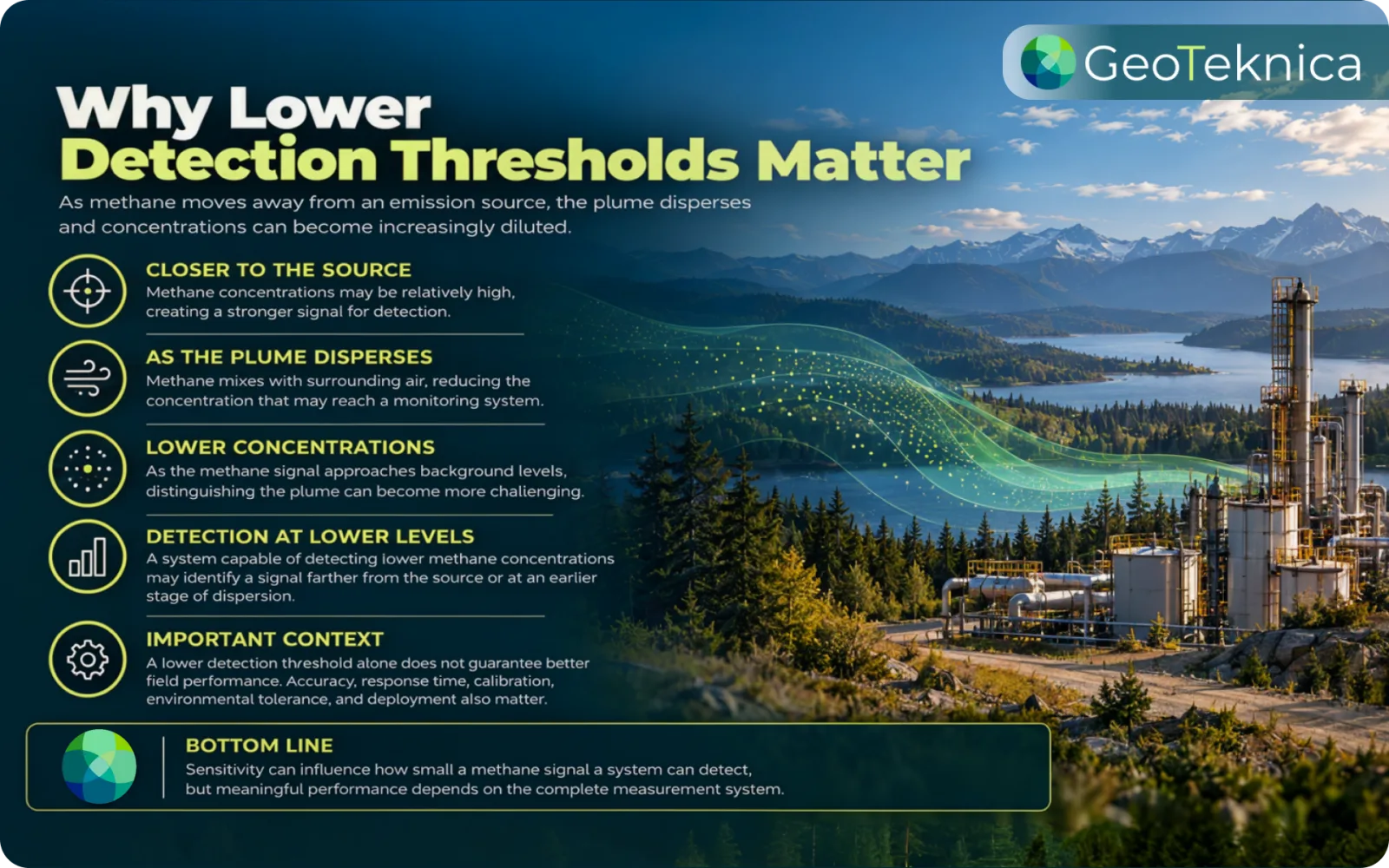
For methane monitoring, the ability to identify lower concentrations can provide additional information about what is happening around equipment and facilities. A system capable of detecting lower levels of ppm methane may identify a methane signal farther from the source or at an earlier stage of dispersion. This can be valuable because methane does not remain concentrated in one location after it enters the atmosphere. As the plume moves away from the source, it becomes increasingly diluted.
A detector therefore has to distinguish the methane signal from the surrounding background concentration. The lower the concentration becomes, the more challenging that measurement can be. This is one reason why sensitivity is an important consideration when evaluating methane detection technologies. It can influence how early a system identifies a methane signal and how far from a source that signal may remain detectable.
However, as has been stated previously, lower sensitivity alone does not guarantee better field performance. The entire measurement system needs to be considered, including accuracy, response time, calibration, environmental tolerance, sampling configuration, and how the technology is deployed.
Putting ppm into perspective
Ultimately, ppm is a way of describing concentration. It tells us how much methane is present relative to the surrounding gas mixture at the point of measurement. It does not, by itself, tell us how much methane a piece of equipment is emitting, how large a leak is, or how much methane will ultimately enter the atmosphere. to answer those questions we require additional information.
Understanding the distinction is particularly important as methane monitoring becomes increasingly sophisticated. Technologies can now detect increasingly small methane concentrations, collect measurements across facilities, and provide information that can support leak detection and emissions management. But the value acquired from that information depends on understanding what the measurements actually represent.
A sensitivity specification should therefore be viewed as one piece of the larger measurement picture. A detector capable of identifying 1 ppm methane is not simply “better” because the number is smaller. The meaningful question is whether that level of sensitivity is appropriate for the application, whether the system can reliably achieve it under the expected operating conditions, and what additional information is available to interpret the measurement.
From a number to a useful measurement
The basic idea behind ppm methane is straightforward: one part methane in one million parts of the measured gas mixture. What is truly more complicated is everything surrounding that number. A reading is influenced by where the measurement occurs, how the gas has dispersed, the characteristics of the instrument, and the conditions under which the measurement is made. Sensitivity tells us how small a methane concentration a system may be capable of detecting, but it should never be interpreted independently from accuracy, uncertainty, range, calibration, and deployment conditions.
Methane monitoring is ultimately about turning measurements into useful information. Understanding the mathematics behind ppm readings makes it easier to interpret sensor specifications, compare detection technologies, and understand what a measurement can and cannot tell us about an emission source.
The number on the screen is only the beginning, knowing what that number means is what makes the measurement useful.
References
National Institute of Standards and Technology. (2019). The International System of Units (SI): NIST Special Publication 330. U.S. Department of Commerce. https://www.nist.gov/pml/special-publication-330
National Institute of Standards and Technology. (2025). How do you measure greenhouse gases? U.S. Department of Commerce. https://www.nist.gov/how-do-you-measure-it/how-do-you-measure-greenhouse-gases
U.S. Environmental Protection Agency. (2024). Overview of greenhouse gases. https://www.epa.gov/ghgemissions/overview-greenhouse-gases
Learn about how GeoTeknica’s device combines high sensitivity with reliable results at GeoTeknica.com