5 Levels of Methane Reporting: From Measurement to the OGMP 2.0 Gold Standard
You cannot manage what you cannot measure. For methane emissions, however, measuring is rarely as simple as putting a number beside a facility on an emissions inventory.
Oil and gas operations are large, complex and constantly changing. Equipment operates under different conditions, emissions can be intermittent, and the same facility can look very different from one measurement campaign to the next. Add to that the growing number of technologies available to detect and quantify methane, and it becomes clear that determining what is actually being emitted is not always straightforward.
OGMP 2.0 has become one of the industry’s most recognized approaches for improving the quality of methane emissions reporting. At the same time, the term “Gold Standard” is frequently used in discussions about what good methane reporting should look like. This has sometimes led to the question of “OGMP vs. the gold standard,” as though the two represent competing approaches. However that is not the case.
OGMP 2.0 is the framework. The Gold Standard represents the highest level of reporting achievement within that framework. The measurement technologies available to operators are the tools that help make that progression possible (United Nations Environment Programme [UNEP], 2026).
Understanding that relationship is becoming increasingly important as the industry moves toward more measurement based emissions management.
From estimating emissions to measuring them
Historically, methane inventories have often relied on emission factors. These factors provide a practical way to estimate emissions based on equipment counts, operating activity and standardized assumptions.
Emission factors remain useful, particularly for building inventories and understanding emissions across large systems. The challenge is that an average value does not always reflect what is happening at a specific facility or piece of equipment.
Two similar pieces of equipment can perform differently. A valve, compressor or storage tank may have an emission profile that differs from the value used in a standard calculation. Equipment condition, maintenance, operating environment and other factors can all influence actual emissions.
OGMP 2.0 was developed in part to address this challenge by encouraging a progression toward more detailed, source level and measurement based reporting (Oil and Gas Methane Partnership [OGMP], 2020).
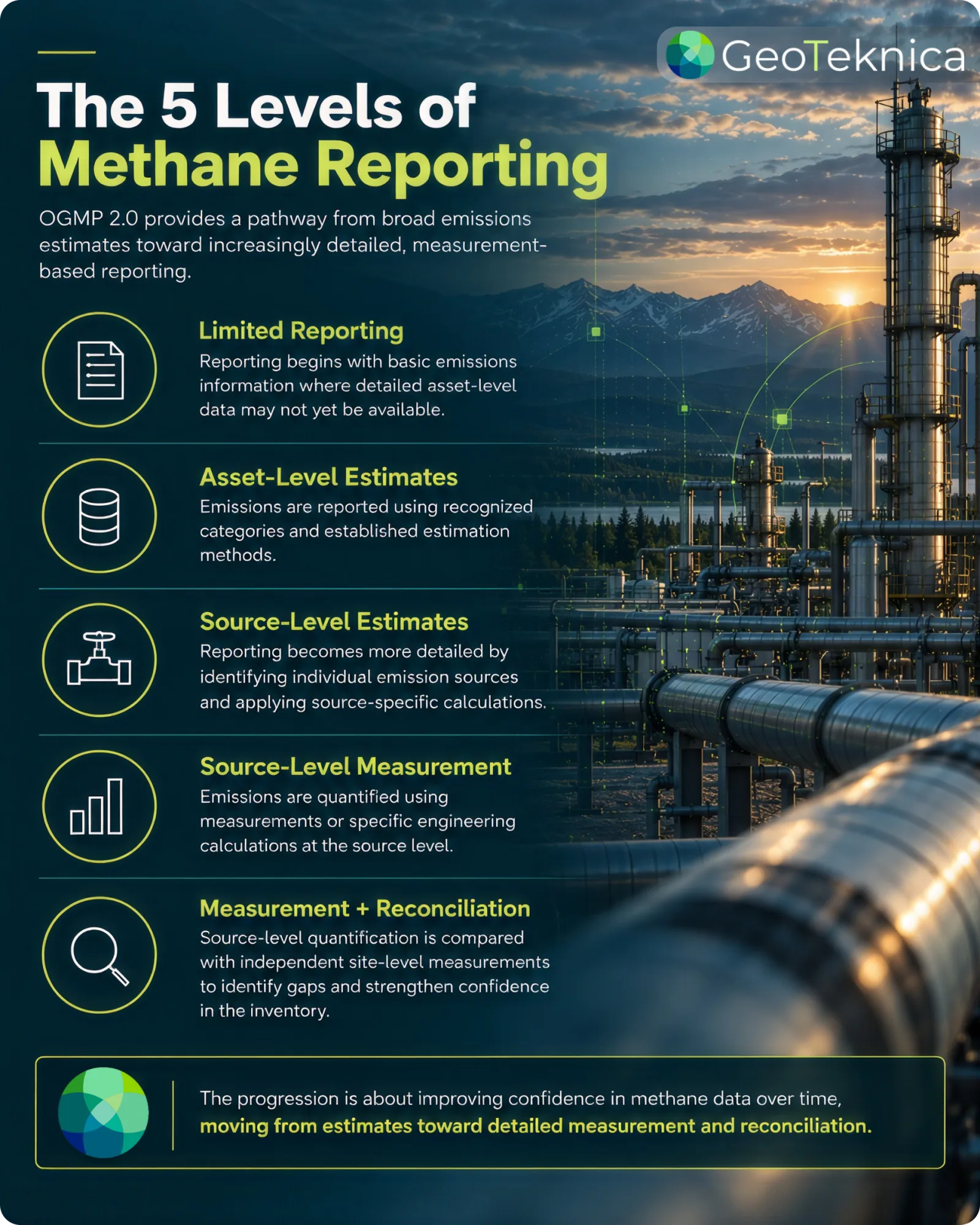
Rather than treating an emissions inventory as a fixed number, the framework recognizes that reporting quality can improve over time. That progression is reflected in the five levels of OGMP 2.0 reporting.
Understanding the 5 levels
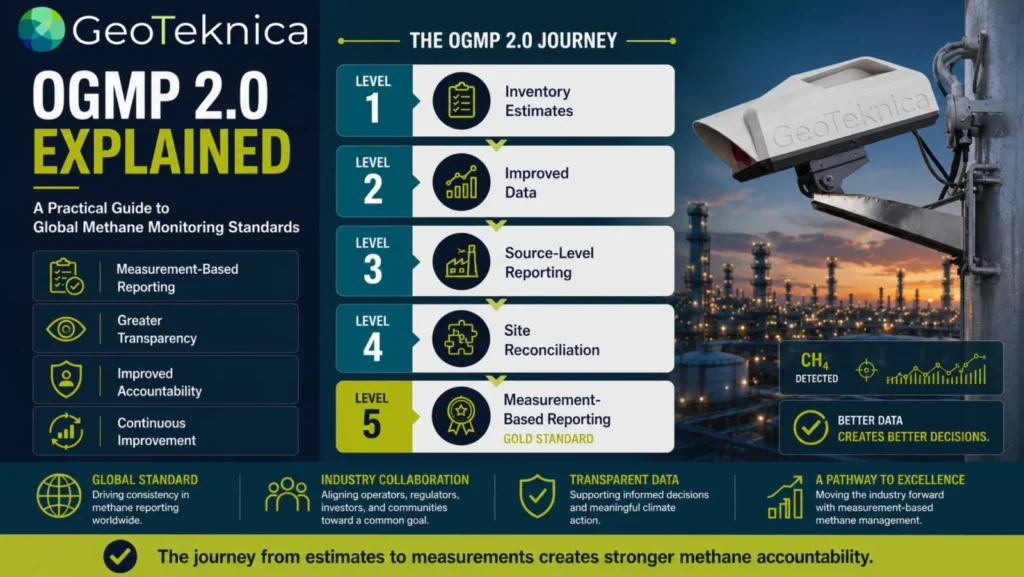
The five reporting levels are best understood as a progression rather than five competing options. At the earlier levels, companies may rely more heavily on estimates and emission factors. As reporting advances, the focus shifts toward increasingly detailed information about individual emission sources and the methods used to quantify them. Level 4 represents source level quantification, while Level 5 adds reconciliation between source level measurements and independent site level measurements (UNEP, 2026).
The importance of this progression is practical. An operator does not necessarily have the ability to measure every methane source directly on day one. A company may operate thousands of pieces of equipment across multiple facilities, regions and operating environments. Developing a measurement programme that is technically robust and operationally realistic takes time.
The value of the framework is that it provides a structured path toward improving that information. Gold Standard Reporting is not a separate methane reporting framework. It is the highest level of reporting recognition within OGMP 2.0. Under the current framework, achieving Gold Standard Reporting requires companies to reach the required higher reporting levels across their material operated and non operated assets within specified timelines (UNEP, 2026).
The Gold Standard is better understood as the destination within the OGMP 2.0 reporting pathway, rather than an alternative to it.
The role of measurement technology
The idea of “OGMP vs. the gold standard” is somewhat misleading as they are not in competition with each other. Once the distinction is clear, the role of methane measurement technologies becomes easier to understand.
Today, operators have access to a much broader range of measurement approaches than they did even a few years ago. Optical gas imaging, continuous monitoring systems, fixed sensors, mobile surveys, aerial measurements and satellite observations can all contribute useful information.
But the question is not as simple as which technology is best. An operator does not have the luxury of choosing a measurement method based solely on which one produces the most detailed dataset. Facility design, site access, safety requirements, weather, operating conditions, cost and the characteristics of the potential emission all influence what can realistically be measured.
The goal is not to measure everything with every available technology. It is to understand which combination of methods provides the most useful and defensible picture of emissions for a particular operation. That is one reason OGMP 2.0 does not prescribe a single piece of technology as the solution. Instead, the framework creates a structure in which different measurement approaches can contribute to increasingly accurate reporting (UNEP, 2026).
This also helps explain why the discussion around “OGMP vs. the gold standard” should not become a debate about one technology versus another. The framework and the technology serve different purposes. The framework establishes how emissions should be characterized and reported. Measurement technologies provide evidence about what is actually happening in the field.
Why no single measurement tells the whole story
Methane emissions are not always consistent or predictable. Some sources emit continuously and others are intermittent. Equipment may begin leaking between inspection campaigns, or a temporary operating condition may create a release that would not be captured during a routine survey. These variations create a measurement challenge.
A technology that is highly effective at finding individual leaks may not provide the same information as a system designed to estimate total emissions from an entire facility. Likewise, a site level measurement can indicate that total emissions are higher than expected without necessarily identifying which individual components are responsible. That does not make one approach better than the other, it means they answer different questions.
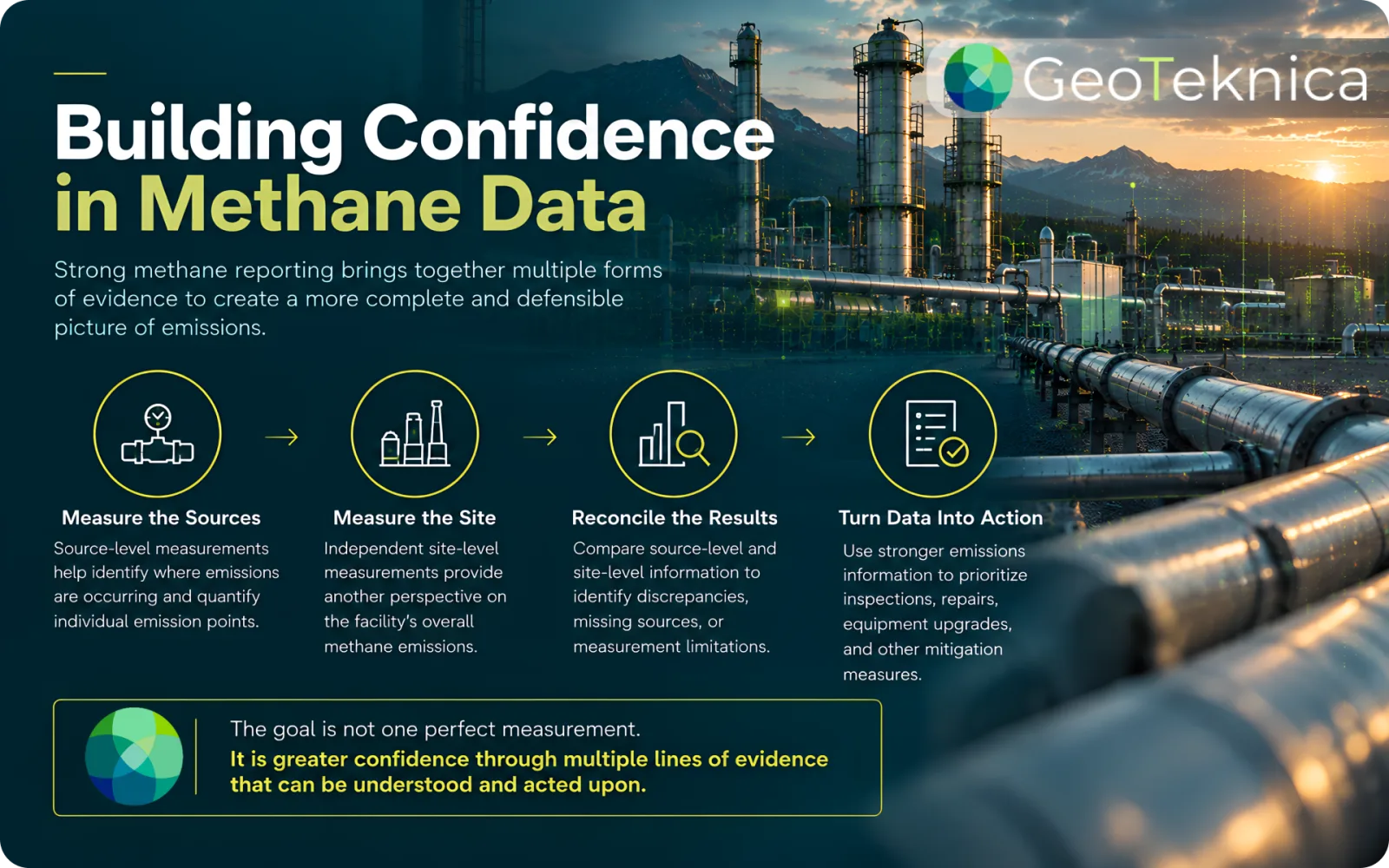
A useful methane measurement programme therefore may need multiple lines of evidence. Source level measurements can help identify where emissions are occurring. Site level measurements can provide another perspective on the overall magnitude. Broader technologies such as aerial or satellite observations can add context at larger scales. OGMP 2.0 provides a framework for bringing these different pieces of information together.
Why reconciliation matters
This becomes particularly important at Level 5. Imagine a facility where a source level inventory identifies several hundred potential emission points. Measurements of those sources are combined to produce an estimate of total methane emissions. An independent site level measurement is then conducted, and the result indicates that the facility is emitting materially more methane than the source level inventory suggests.
At first, that discrepancy might seem like a problem. In reality, it can be one of the most useful pieces of information available as the difference creates a question: where is the gap?
Perhaps an intermittent source was missed. Perhaps an emission factor is not representative of the equipment in question. Perhaps operating conditions changed between measurements. Or perhaps one of the measurement methods has a limitation that needs to be better understood. The important point is that reconciliation turns uncertainty into something that can be investigated.
UNEP describes Level 5 as the reconciliation of source level quantification with independent site level measurements. Site level measurements do not replace source level quantification. Instead, they provide an additional check on the overall inventory and can help identify gaps that warrant further investigation (UNEP, 2026).
The objective is not to find one perfect measurement and declare the issue solved. It is to build increasing confidence through multiple lines of evidence.
From measurement to mitigation
Better reporting only matters if it leads to better decisions. A highly detailed emissions inventory is useful, but the real value comes when operators can use that information to prioritize action.
Consider a facility with hundreds of potential emission sources. A conventional inventory might suggest that emissions are relatively evenly distributed across those sources. More detailed measurement could reveal that a relatively small number of sources are responsible for a much larger share of total emissions.
Instead of treating every source equally, an operator can prioritize inspections, repairs, equipment replacement or other mitigation measures where they are likely to make the greatest difference. This is one of the broader benefits of moving toward measurement based reporting. It connects environmental performance more directly with operational decision making.
The International Methane Emissions Observatory also reflects this broader approach. UNEP’s programme combines company reported data through OGMP 2.0 with other sources of information, including satellite observations and scientific measurement studies, to improve understanding of methane emissions at larger scales (UNEP, 2026).
The objective is not simply to create a better database, it is to retrieve higher quality information and use it for better action.
Moving beyond “OGMP vs. the gold standard”
The conversation around methane reporting can become overly focused on whether a particular reporting methodology, measurement technology or standard is the “best” available. For operators, the more useful question is how these pieces work together to create the best plan of action.
OGMP 2.0 provides a common reporting framework and a pathway toward increasingly detailed and measurement based reporting. Measurement technologies provide the field data needed to support that reporting. Reconciliation adds another level of confidence by comparing source level information with independent measurements. Gold Standard Reporting recognizes organizations that have progressed to the highest reporting levels within the framework.
In that context, “OGMP vs. the gold standard” is not really an either or decision. It is a progression. The same principle applies to technology. Today’s most effective measurement approach may not be the industry’s preferred approach a decade from now. Sensors will continue to improve, satellite capabilities will expand, analytical tools will become more sophisticated, and new measurement methods will emerge. A useful reporting framework will accommodate that progress rather than compete with it.
What good methane reporting ultimately looks like
The most useful methane reporting system is not necessarily the one with the most complicated methodology or the most sophisticated technology. It is the one that gives operators enough confidence in the data to understand where emissions are occurring, how significant they are and what can be done about them. That is ultimately the value of the OGMP 2.0 framework.
The five reporting levels provide a practical pathway from broad estimates toward increasingly detailed measurement. The Gold Standard represents the highest reporting achievement within that pathway. And the growing range of measurement technologies gives operators more tools to understand what is happening across their facilities.
The goal is not simply to produce a better number, it is to produce a number that can be trusted, understood and acted upon. For an industry managing complex infrastructure at a global scale, that is what makes methane measurement useful. And it is why the future of methane reporting is likely to be less about choosing one approach over another and more about bringing the right approaches together.
References
Oil and Gas Methane Partnership. (2020). Oil and Gas Methane Partnership (OGMP) 2.0 framework. United Nations Environment Programme. https://www.ccacoalition.org/resources/oil-and-gas-methane-partnership-ogmp-20-framework
United Nations Environment Programme. (2022). An eye on methane: International Methane Emissions Observatory 2022 report. UNEP report webpage
United Nations Environment Programme. (2026). Frequently asked questions: Oil and Gas Methane Partnership 2.0 (OGMP 2.0). International Methane Emissions Observatory. OGMP 2.0 FAQ
United Nations Environment Programme. (2026). International Methane Emissions Observatory. UNEP International Methane Emissions Observatory
United Nations Environment Programme. (2026). OGMP 2.0 resources. Oil & Gas Methane Partnership 2.0. OGMP 2.0 resources
5 Levels of Methane Reporting: From Measurement to the OGMP 2.0 Gold Standard