OGMP 2.0 Levels 4/5 Explained: What Source Level Reporting Really Requires
Methane reporting in the oil and gas industry is progressively relying on measurement based action and planning. As companies work to better understand and reduce methane emissions, the conversation is moving beyond estimating total emissions and toward a much more detailed question: Where, specifically, are those emissions coming from? Levels 4 and 5 of the Oil and Gas Methane Partnership 2.0, or OGMP 2.0, framework explore this.
For companies working toward the OGMP 2.0 Gold Standard, reaching these levels requires more than adding additional data to an emissions inventory. It requires a more detailed understanding of individual emission sources, the use of source specific information, and, at Level 5, reconciliation between source level estimates and measurements taken at the site level. The result is a reporting approach designed to make methane inventories more representative of what is actually happening in the field.
From Estimates to Source Level Reporting
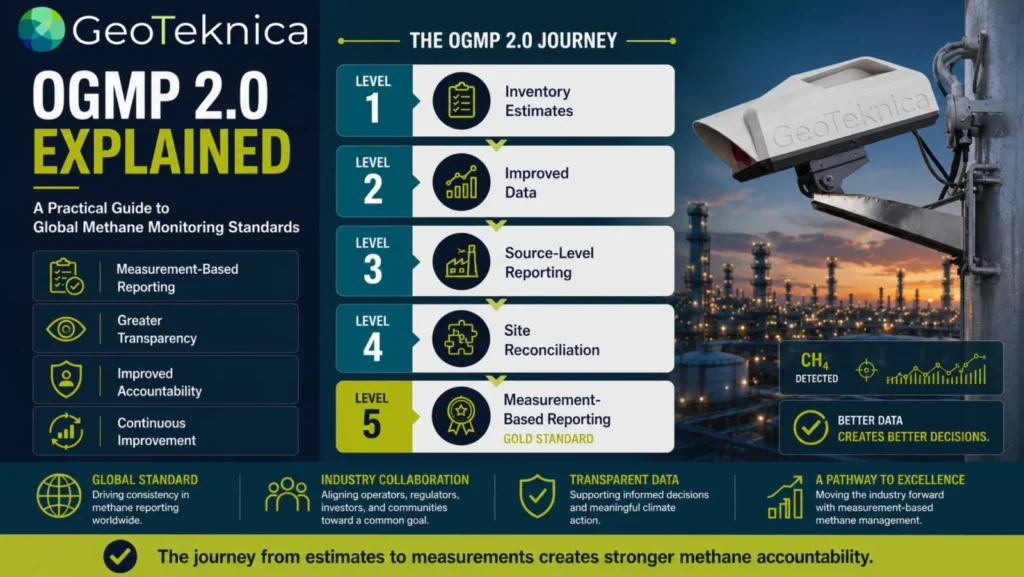
The OGMP 2.0 framework includes five reporting levels, with each level representing an improvement in the granularity and quality of methane emissions data. At the lower levels, companies may rely on consolidated emissions estimates or generic emission factors. These approaches can provide a useful starting point, particularly when detailed information is not yet available. However, they can also obscure the differences between individual facilities, equipment types, operating conditions and emission sources.
Level 3 moves toward detailed source categories, but still generally relies on generic emission factors. Level 4 takes an important step further by requiring emissions to be reported by detailed source type using specific emission and activity factors. These factors can be informed by direct measurement, source specific information, engineering calculations, simulation or other appropriate quantification methods (UNEP, 2023).
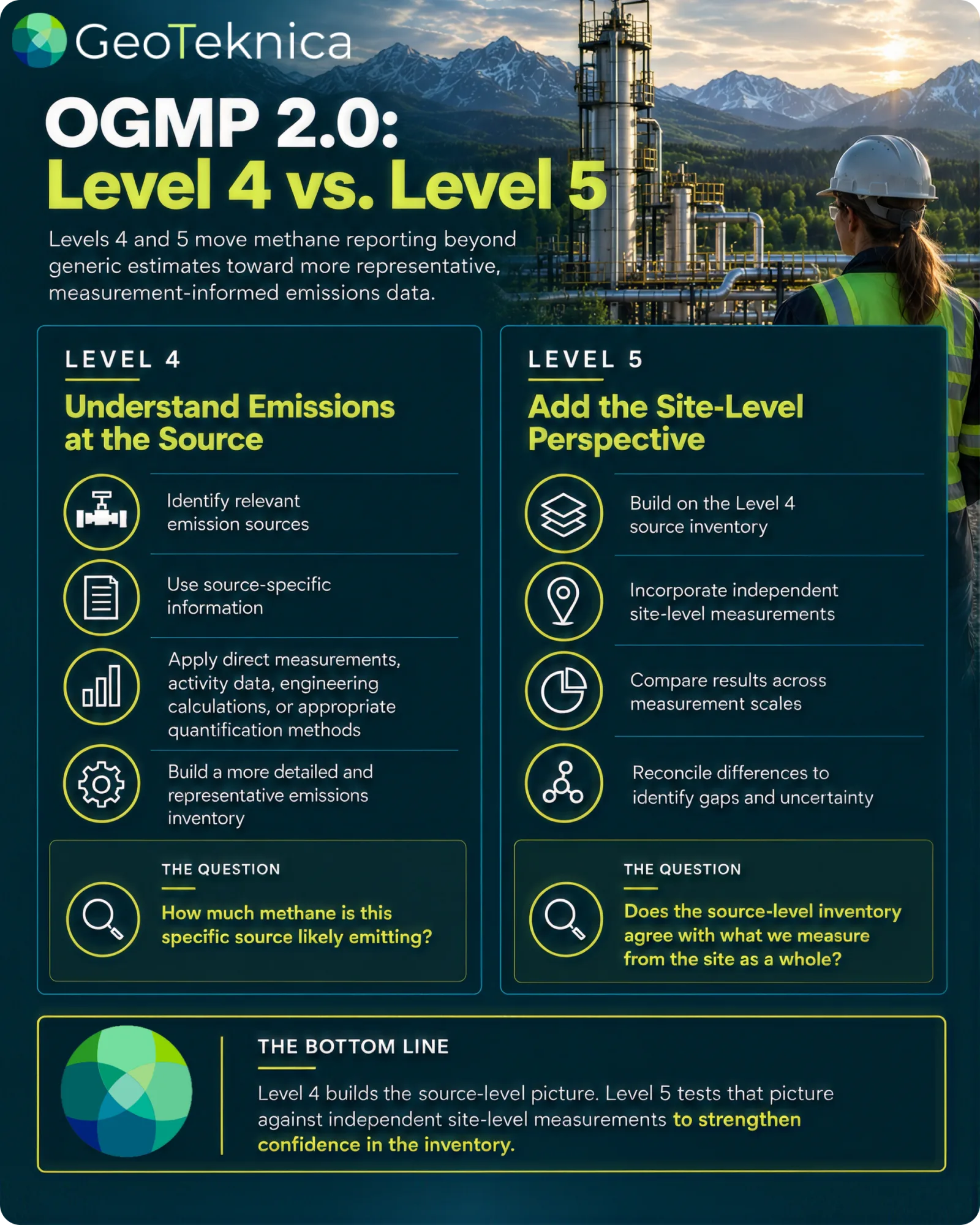
In practical terms, Level 4 asks companies to move away from the question, “How much methane does this type of equipment typically emit?” and toward, “How much methane is this specific source at this specific operation likely emitting?”
Oil and gas facilities are not static environments. Equipment condition, operating pressure, maintenance activities, production rates, weather, age and operating practices can all influence emissions. Applying a single generic factor across a large population of equipment may therefore miss important differences between facilities. Source level reporting is intended to capture more of that variability and provide better insight.
What Level 4 Actually Requires
Level 4 is often described as source level reporting, but the term can make the requirement sound simpler than it is. A company needs to identify relevant emission sources and quantify them using information that is specific to those sources wherever appropriate. This can include direct measurements, source specific emission factors, activity data, engineering calculations and other approved quantification approaches.
The objective is not necessarily to measure every individual piece of equipment continuously. Rather, the objective is to develop an emissions inventory that is sufficiently detailed and representative to provide confidence in the reported numbers. This distinction is important because there is no single technology that can measure every methane source under every operating condition.
For example, a facility may use one approach for fugitive emissions, another for pneumatic equipment, another for tanks and another for venting events. Depending on the source and facility, technologies can include optical gas imaging, continuous monitoring, flow measurement, remote sensing, engineering calculations or other measurement based methods.
The International Association of Oil & Gas Producers notes that methane detection, measurement and quantification approaches can vary depending on factors such as asset type and environmental conditions. It also distinguishes between technologies that identify a methane source and technologies capable of quantifying the amount being emitted (IOGP, 2023), which is an important consideration when developing a Level 4 program. Finding a source is not necessarily the same as measuring it.
A strong source level inventory needs to connect detection, quantification and reporting in a way that produces useful data.
Level 5: Adding the Site Level Perspective
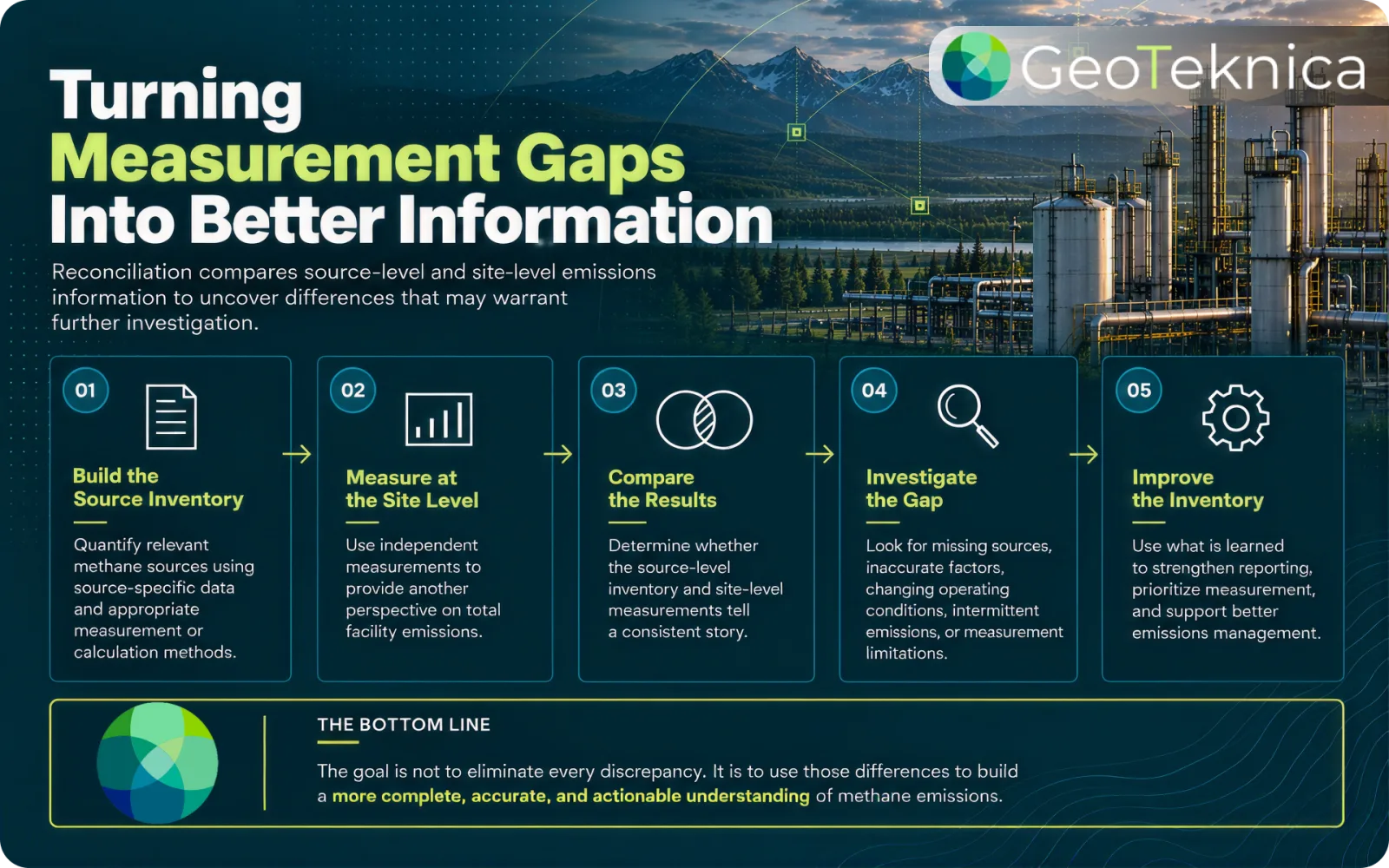
If Level 4 is about understanding emissions at the source, Level 5 asks a broader question: Does the source level inventory agree with what we measure from the site as a whole? Level 5 builds on Level 4 by incorporating independent site level measurements and reconciling those measurements with the source level inventory.
This is sometimes described as a bottom up versus top down comparison. The terminology can be useful, but it can also be misleading. Level 5 does not mean replacing source level measurements with a single site level measurement. In fact, the two approaches serve different, important, purposes.
Source level information helps identify what is contributing to emissions and allows operators to prioritize mitigation activities. Site level measurements provide an independent perspective on the overall emissions from a facility. Comparing the two can reveal gaps, uncertainties or previously unidentified sources.
The OGMP 2.0 framework specifically states that Level 5 is not simply synonymous with site level or top down measurement. Instead, it involves reconciliation between the Level 4 source level inventory and independent site level measurements. The purpose is to improve the completeness, accuracy and confidence of the inventory (UNEP, 2026).
Imagine a facility where the source level inventory estimates 100 tonnes of methane emissions per year. A site level measurement campaign produces a materially different result. The discrepancy does not automatically mean one measurement is wrong. Instead, it highlights a reason to investigate.
Are certain sources missing from the inventory? Are emission factors too low or too high? Were operating conditions different during the measurement period? Are there intermittent emissions that were not captured? Could there be an unidentified source? The reconciliation process turns the difference into useful information.
Why Reconciliation Matters
One common misconception is that achieving Level 4 or Level 5 means every possible source at every facility must be measured in exactly the same way. The framework takes a more practical approach.
OGMP 2.0 uses materiality rules to help companies prioritize their efforts. According to the partnership’s current guidance, companies should prioritize Level 4 reporting for the sources that represent the majority of emissions from an asset. The guidance identifies sources representing at least 70 percent of an asset’s methane emissions as a minimum focus for Level 4 reporting, with justification required where coverage does not extend beyond 90 percent (UNEP, 2026).
This approach recognizes an important operational reality: resources are limited, and the most effective measurement program is not necessarily the one that collects the most data. It is the one that collects the right data.
For operators, that means understanding which sources are likely to have the greatest impact, improving measurement quality around those sources and progressively expanding coverage as the program develops.
What This Means for Operators
Moving toward Levels 4 and 5 can require a significant change in how methane data is collected and managed. It may involve improving equipment inventories, strengthening activity data, establishing measurement programs, training personnel, evaluating technologies and developing processes for reconciling measurements across different data sources.
It also requires collaboration between teams that may traditionally operate somewhat independently. Engineering, operations, environmental teams, measurement specialists and data management teams all have a role to play. The benefit is that better reporting can support better decisions.
A detailed methane inventory can help operators identify which sources deserve attention, where measurement uncertainty is greatest and where mitigation efforts may provide the greatest benefit. In other words, reporting becomes more than an exercise in documentation. It becomes part of the process of managing emissions.
Measurement Is Only Useful If It Leads to Better Decisions
Within the OGMP 2.0 framework the progression from Level 1 through Level 5 reflects a broader change in how the industry approaches methane management.
Early emissions inventories often had to rely heavily on estimates and generic emission factors. As measurement technologies, data systems and industry knowledge have improved, companies have gained more opportunities to understand emissions at the source.
Level 4 provides greater confidence by connecting reported emissions to specific sources and more representative data. Level 5 adds an independent site level perspective and creates an opportunity to identify discrepancies that may otherwise remain hidden.
For operators, the objective should not simply be to achieve a reporting level and check a box. The more useful objective is to build an emissions measurement and management system that becomes progressively more accurate and actionable over time.
Better data does not reduce emissions by itself, however it can show operators where emissions are occurring. It can also help prioritize mitigation and provide a stronger basis for measuring whether those efforts are working, making source level reporting so important for continuous improvement.
The real value of Levels 4 and 5 of OGMP 2.0 is not just that they produce a better number. It is that they help turn that number into information that operators can use.
References
International Association of Oil & Gas Producers. (2023). Methane emissions detection and quantification. IOGP. https://www.iogp.org/workstreams/environment/environment/methane-emissions-detection-and-quantification/
United Nations Environment Programme. (2026). Frequently asked questions: The Oil & Gas Methane Partnership 2.0. Oil & Gas Methane Partnership. https://www.ogmpartnership.org/frequently-asked-questions
United Nations Environment Programme. (2026). Resources: Oil & Gas Methane Partnership 2.0. Oil & Gas Methane Partnership. https://www.ogmpartnership.org/resources
OGMP 2.0 Levels 4/5 Explained: What Source Level Reporting Really Requires