Methane Plume Dispersion: The Physics Behind Detection Sensitivity
A methane leak can be relatively easy to detect close to it’s source and significantly more difficult to detect as it moves farther downwind. The emission itself may not have changed, yet the signal reaching a monitoring system can be dramatically different. This is not necessarily a limitation of the sensor. It is a consequence of how methane behaves once it enters the atmosphere.
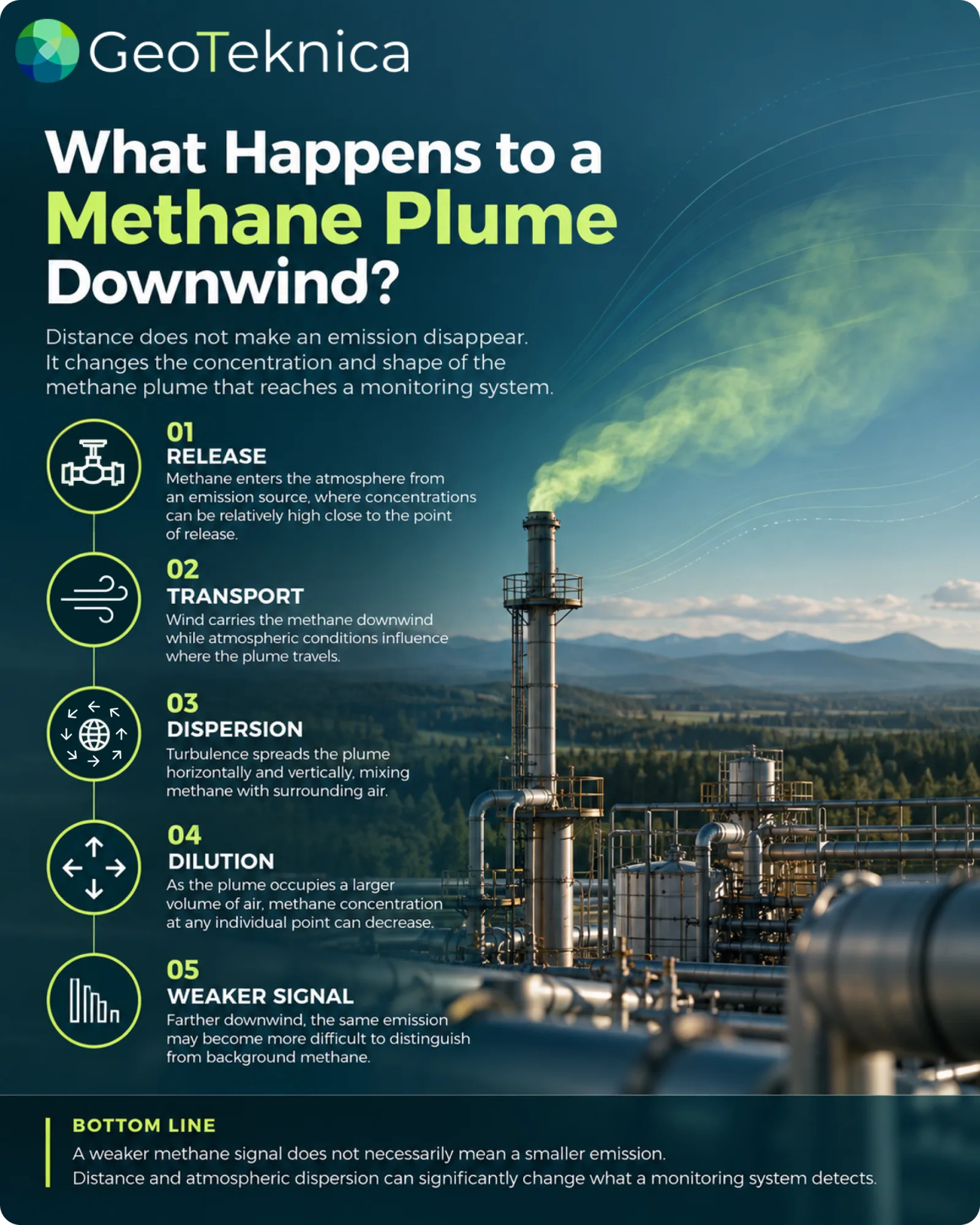
When methane is released from a valve, flange, tank or other piece of equipment, it does not travel through the atmosphere as a concentrated cloud that maintains the same shape and concentration. Wind carries the gas downwind while atmospheric turbulence mixes it with the surrounding air. As the plume travels, it spreads horizontally and vertically, increasing the volume of air containing methane and reducing its concentration at any individual point.
This process, known as methane plume dispersion, is one of the fundamental physical considerations in methane monitoring. Understanding it helps explain why distance can have such a significant effect on detection sensitivity and why a monitoring technology cannot be evaluated solely by looking at its advertised detection limit.
A methane plume does not stay still
Consider a small leak from a valve, flange or other component at an oil and gas facility; close to the source, the methane concentration can be substantially higher than the surrounding atmosphere. If a sensor is positioned close to the source and intersects the plume, the resulting methane signal can be relatively strong. Wind then transports the methane while atmospheric turbulence mixes it with surrounding air. The amount of spreading generally increases as the plume travels farther from its source reducing the concentration.
The U.S. Environmental Protection Agency describes atmospheric dispersion in terms of horizontal and vertical spreading that increases with distance from an emission source. Wind speed and atmospheric turbulence are important factors influencing how quickly that spreading occurs (U.S. Environmental Protection Agency, 1982).
The important point is that the total amount of methane being released does not necessarily have to change for the concentration measured by a sensor to decrease. The same emission can produce a strong signal near the source and a much weaker signal farther downwind simply because the methane has mixed into a larger volume of air.
Why distance matters to detection
Detection technologies ultimately have to distinguish a methane signal from background conditions. Methane is already present in the atmosphere at relatively low concentrations, so a monitoring system needs enough contrast between the plume and the surrounding atmosphere for an emission to stand out.
This is where methane plume dispersion becomes particularly important. Imagine two identical leaks producing exactly the same emission rate. One sensor is positioned close to the source, while another is positioned substantially farther downwind. The second sensor may encounter a plume that has spread across a much larger area, meaning the methane concentration at the sensor could be considerably lower. The equipment has not necessarily become less sensitive. Instead, the physical signal reaching the equipment has become weaker.
Research into methane measurements using Gaussian plume reconstruction demonstrates this relationship in real field conditions. Foster Wittig et al. (2015) evaluated methane releases at different distances downwind and found that plume geometry, wind direction and atmospheric conditions were important considerations when reconstructing emission sources and estimating emission rates.
This difference is important as a low measured concentration does not automatically mean a low emission rate. It may instead mean that the measurement was taken farther from the source, under stronger wind, during greater atmospheric turbulence or outside the centre of the plume.
Wind is only part of the equation
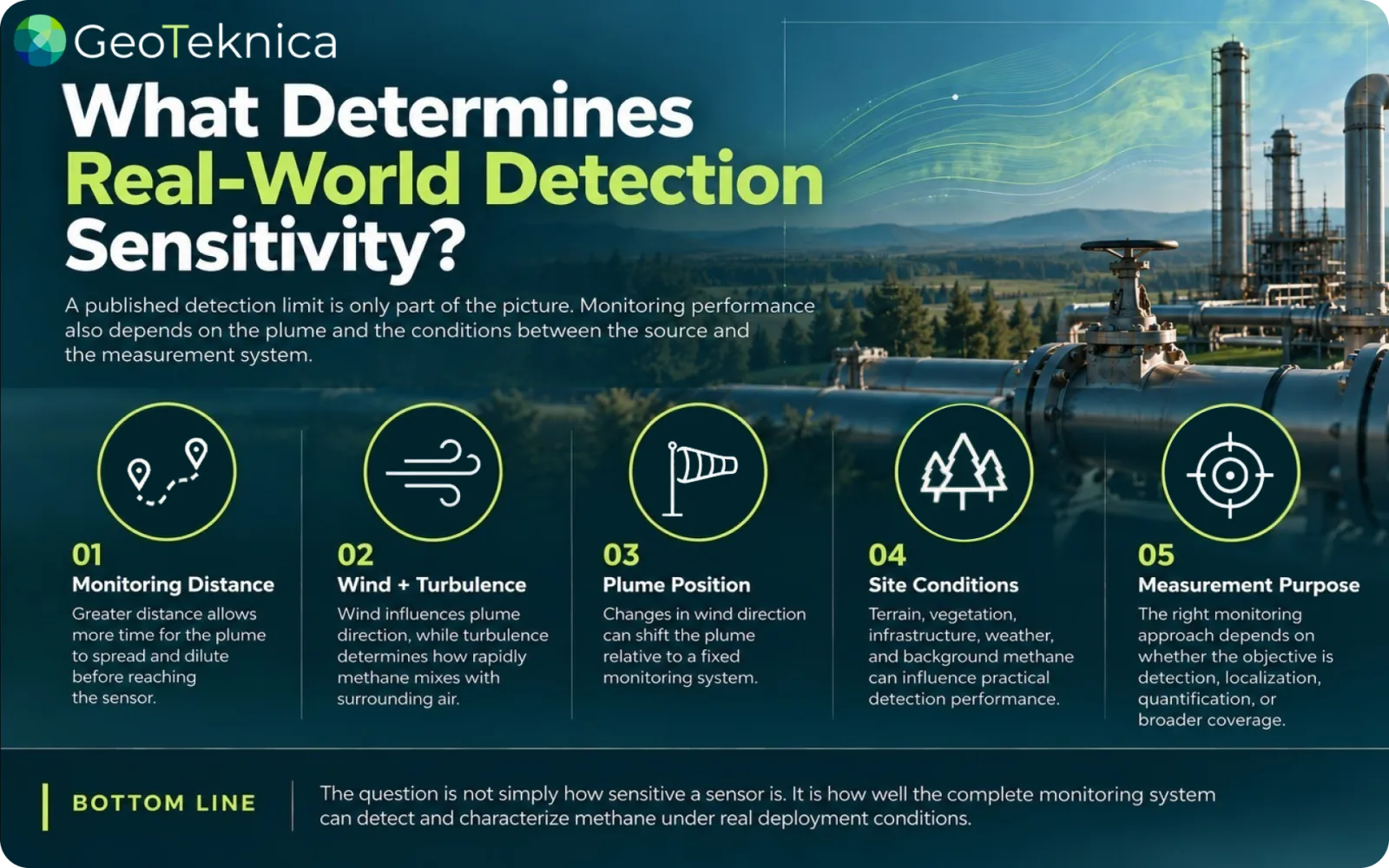
It is tempting to think of wind as simply carrying methane from one location to another, but atmospheric transport is more complicated than that. Wind determines the general direction in which a plume travels, while turbulence influences how quickly it spreads and mixes with the surrounding atmosphere.
Under relatively stable atmospheric conditions, a plume may remain more concentrated and coherent for longer distances. Under turbulent conditions, mixing can happen much more rapidly, causing the plume to become broader and more difficult to distinguish from background methane.
This is why methane plume dispersion cannot be separated from weather and atmospheric conditions. Wind speed also plays a role. Faster winds can transport an emission away from its source more quickly, while also contributing to dilution. Changes in wind direction can create another challenge because the location of the plume can shift relative to a fixed monitoring system.
For monitoring programs, this means that a technology’s published detection limit should not be considered completely independent of deployment conditions. A sensor might have an impressive theoretical detection limit under controlled conditions, but the practical probability of detecting an emission can be very different when wind, turbulence, terrain, vegetation, infrastructure and background concentrations are introduced.
The plume can become harder to find before it becomes harder to measure
There is an important distinction between detecting methane and locating its source. A sensor may be capable of measuring extremely small methane concentrations, but that does not necessarily mean it can reliably determine where those concentrations originated.
As methane plume dispersion increases the physical footprint of a plume, the concentration gradient can become less distinct. A monitoring system may detect elevated methane somewhere within an area while still having difficulty determining exactly which piece of equipment is responsible.
This becomes particularly relevant for technologies that operate at longer stand off distances. Research involving remote methane sensing has demonstrated that measurement performance depends on factors such as path length, wind conditions and plume structure. Khan et al. (2023), for example, examined methane plume localization using remote sensing techniques and atmospheric dispersion modelling, highlighting the importance of understanding how a plume behaves between the source and the measurement system.
This does not mean that longer distance monitoring is ineffective. Longer range technologies can provide valuable coverage across large and difficult to access areas. Rather, it means that distance needs to be considered as part of the measurement itself.
There is no single perfect monitoring distance
Because methane plume dispersion is affected by both the emission and the atmosphere, there is no universal distance at which methane should be monitored. Different technologies observe emissions at different scales and serve different purposes.
A close range sensor can provide detailed information about individual components or localized areas. A mobile platform can cover a larger area and investigate multiple potential sources, while aircraft and satellite based systems can provide much broader spatial coverage. Each approach encounters the methane plume at a different point in its atmospheric journey. That is why effective methane monitoring increasingly relies on complementary technologies rather than treating one technology as the solution for every application.
OGMP 2.0 recognizes this principle. The framework does not prescribe one specific methane detection technology because different technologies have different capabilities and limitations depending on the application. Instead, it emphasizes fit for purpose monitoring, appropriate detection limits and sufficient measurement frequency (OGMP 2.0, 2026).
In other words, the useful question is not simply how sensitive a sensor is. It is how well the entire measurement system can detect and characterize an emission under the conditions in which it will actually be deployed.
Bringing the physics into methane management
Understanding methane plume dispersion helps explain why methane monitoring is ultimately an exercise in both measurement science and atmospheric science. A sensor can be highly sensitive and still miss an emission, while a powerful imaging system can identify a plume but require additional measurements to attribute it to a specific source.
These measurements are not necessarily contradictory. They are observing the same physical process from different positions and under different atmospheric conditions.
The most effective monitoring strategies recognize this reality by considering the source, expected emission magnitude, prevailing weather, monitoring distance, detection threshold and purpose of the measurement when selecting and interpreting monitoring technologies.
This becomes increasingly important as the industry moves toward more measurement based approaches to methane management. Better understanding of methane plume dispersion can help ensure that monitoring programs are designed around how methane actually behaves in the atmosphere rather than relying solely on simplified assumptions about how an emission should appear.
Ultimately, distance does not make an emission disappear. It changes the concentration and shape of the plume that reaches the monitoring system, making the emission progressively more difficult to distinguish from the surrounding atmosphere.
For anyone designing, selecting or interpreting methane monitoring systems, understanding that physical relationship is essential. The question is not simply whether a technology can detect methane. It is whether it can detect the methane that actually reaches it, under the conditions in which it is being used.
References
Foster Wittig, T. A., Thoma, E. D., & Albertson, J. D. (2015). Estimation of point source fugitive emission rates from a single sensor time series: A conditionally sampled Gaussian plume reconstruction. Atmospheric Environment, 115, 101–109. https://doi.org/10.1016/j.atmosenv.2015.05.042
https://www.sciencedirect.com/science/article/pii/S135223101530114X
Soskind, M. G., Li, N. P., Moore, D. P., Chen, Y., Wendt, L. P., McSpiritt, J., Zondlo, M. A., & Wysocki, G. (2023). Stationary and drone assisted methane plume localization with dispersion spectroscopy. Remote Sensing of Environment, 289, 113513. https://doi.org/10.1016/j.rse.2023.113513
https://www.sciencedirect.com/science/article/pii/S0034425723000640
Pierce, T. E., Turner, D. B., Catalano, J. A., & Hale, F. V. (1982). PTPLU: A single source Gaussian dispersion algorithm user’s guide (EPA 600/8 82 014). U.S. Environmental Protection Agency.
https://nepis.epa.gov/Exe/ZyPURL.cgi?Dockey=2000BFRH.txt
Oil & Gas Methane Partnership 2.0. (2026). Frequently asked questions. United Nations Environment Programme.
https://www.ogmpartnership.org/frequently-asked-questions
Methane Plume Dispersion: The Physics Behind Detection Sensitivity