Continuous Monitoring vs. Periodic Surveys: The Case for Always-On Methane Detection

In the fight against climate change, methane monitoring has emerged as an increasingly important part of emissions management. Methane is a powerful greenhouse gas, and because it remains in the atmosphere for a much shorter period than carbon dioxide, reducing methane emissions can have a meaningful impact on near-term warming. The International Energy Agency (IEA) estimates that methane is responsible for around 30% of the rise in global temperatures since the Industrial Revolution, while the energy sector accounts for more than 35% of methane emissions attributable to human activity (IEA, 2025).
For the oil and gas industry, this makes accurate and timely methane detection an important part of responsible operations. Identifying where emissions occur is the first step; understanding when they occur, how long they persist, and how their magnitude changes over time is what allows operators to respond effectively.
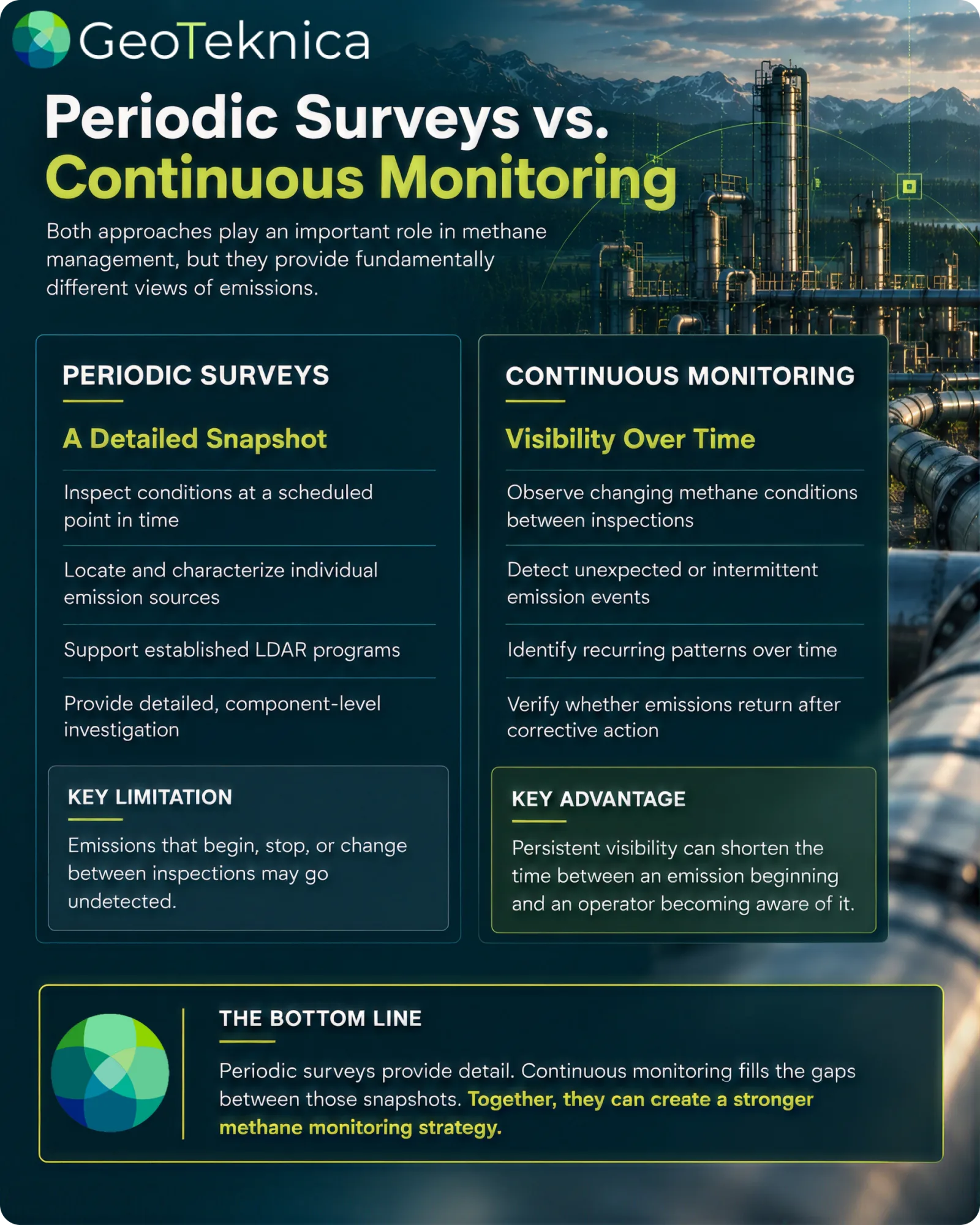
Traditionally, methane emissions have often been identified through periodic surveys, such as optical gas imaging, Method 21 measurements, or other scheduled inspections. These approaches remain valuable and can provide detailed information about individual equipment and emission sources. However, a scheduled survey only provides a snapshot of conditions at the time it is conducted.
Continuous monitoring offers a different approach. Rather than waiting for the next inspection, always-on systems continuously observe operating conditions and can alert operators when methane concentrations change or an unexpected emission event occurs. This article explores the differences between the two approaches and why continuous monitoring can provide an important additional layer of protection for modern methane management programs.
The Importance of Methane Monitoring
Methane is particularly important to monitor because its climate impact is significant while its atmospheric lifetime is relatively short. According to the IEA, methane remains in the atmosphere for roughly 12 years, compared with centuries for carbon dioxide, but absorbs considerably more energy while it is present. This combination means that reducing methane emissions can contribute to near-term climate benefits (IEA, 2025).
The scale of the challenge is substantial. The IEA estimates that energy-related methane emissions were approximately 145 million tonnes in 2024, with oil operations accounting for around 45 million tonnes and natural gas operations for nearly 35 million tonnes (IEA, 2025). At the same time, the agency notes that many of the technologies and practices required to reduce emissions are already available.
Effective monitoring therefore plays an important role in turning methane reduction from a broad objective into an actionable process. Operators need reliable information to identify emission sources, prioritize repairs, verify that mitigation measures have worked, and understand whether emissions are recurring.
This is where the difference between periodic and continuous monitoring becomes particularly important. A periodic survey can answer the question, “Is there a leak here today?” Continuous monitoring can help answer a much broader set of questions: “When did the leak begin? How frequently does it occur? Did it stop after maintenance? Has the emission returned? Are there patterns associated with certain operating conditions?”
The more frequently emissions are observed, the greater the opportunity to understand those patterns and respond before a relatively small problem becomes a prolonged emission event.
Continuous Monitoring: An Overview
Continuous monitoring involves the use of technologies capable of observing methane concentrations or emissions conditions on an ongoing basis. Depending on the application, these systems may use fixed sensors, sensor networks, cameras, or other advanced detection technologies positioned around a facility.
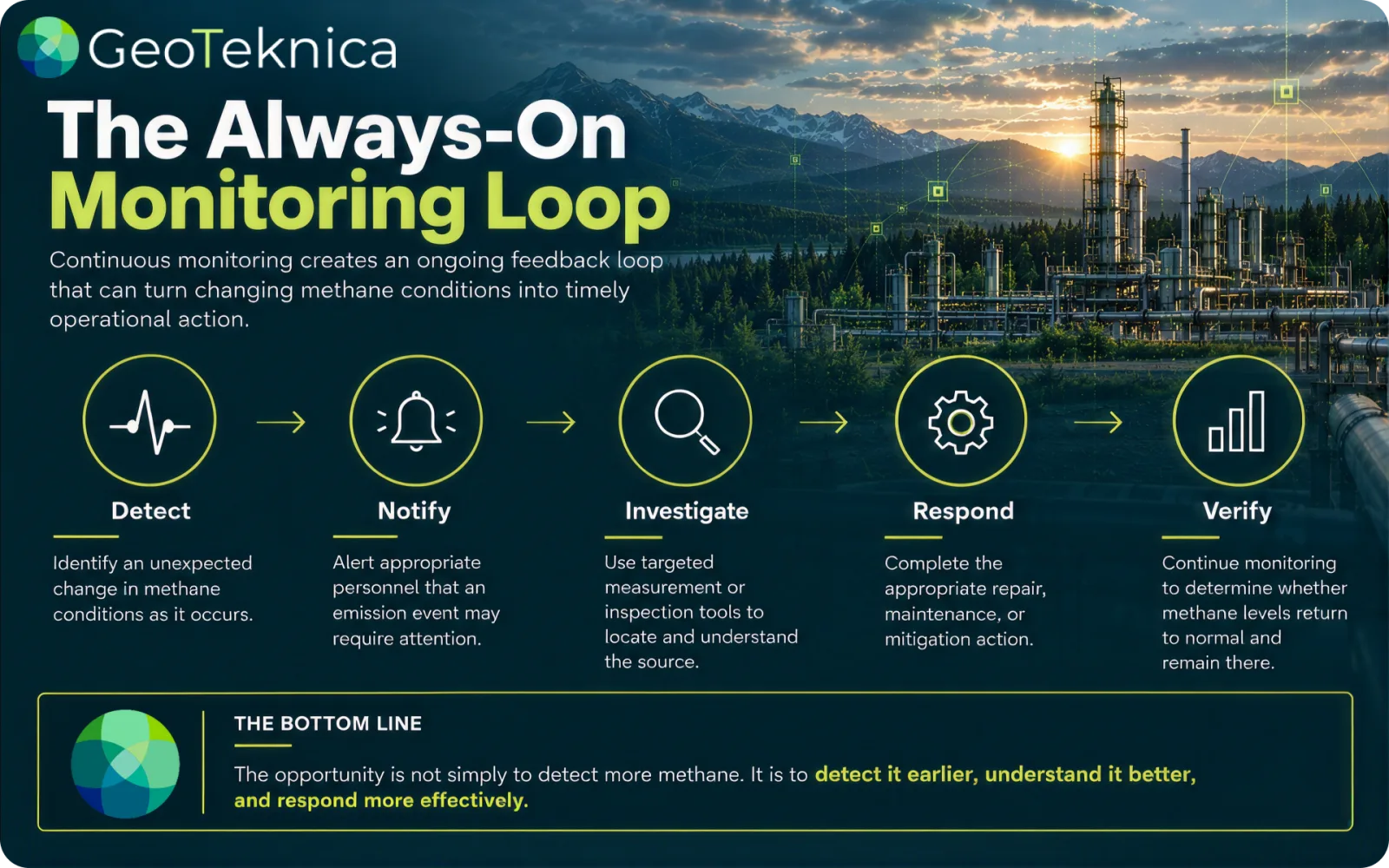
The objective is not simply to collect more data. The real value lies in creating a continuous feedback loop between detection, notification, investigation and response.
For example, a fixed sensor network could identify an unexpected increase in methane concentration and generate an alert. An operator could then investigate the affected area using a more precise technology, identify the source, complete the necessary repair and use subsequent monitoring to determine whether the emission has been resolved.
This approach is increasingly being recognized by regulators and industry organizations. The U.S. Environmental Protection Agency (EPA), for example, recognizes continuous monitoring alongside technologies such as aerial surveys, unmanned aircraft systems, satellite detection and ground-based mobile monitoring as advanced approaches for methane detection (U.S. EPA, 2026).
Importantly, continuous monitoring does not necessarily mean that every piece of equipment needs its own dedicated sensor. Depending on the facility and risk profile, systems can be designed strategically to provide coverage of higher-risk areas or sources while using other technologies to investigate and quantify detected events.
Advantages of Continuous Monitoring
One of the primary benefits of continuous monitoring is its ability to provide timely detection. Instead of discovering an emission during the next scheduled inspection, operators can receive an indication that something has changed much sooner. This can significantly shorten the time between the beginning of an emission event and the start of an investigation.
That time factor matters. A leak that persists for several hours is very different from one that persists for several weeks or months. Even when the instantaneous emission rate is relatively modest, the cumulative emissions from a persistent leak can become significant.
Continuous monitoring can also capture intermittent and transient events that may be difficult to identify through scheduled inspections. Equipment does not necessarily emit methane at a constant rate. Operating conditions, pressure changes, equipment cycling, maintenance activities and process upsets can all influence emissions. A survey conducted on a single day may therefore provide an accurate picture of conditions at that moment while missing what happens before or after the survey.
A continuous dataset can provide a much more complete operational picture. Over time, operators can identify recurring patterns, distinguish isolated incidents from persistent problems and investigate whether certain operating conditions are associated with elevated methane concentrations.
Another advantage is the ability to verify corrective action. Finding and repairing a leak is only part of the process. Operators also need confidence that the repair was effective. Continuous monitoring can provide an additional layer of verification by showing whether methane levels return to normal following maintenance and whether the emission subsequently reappears.
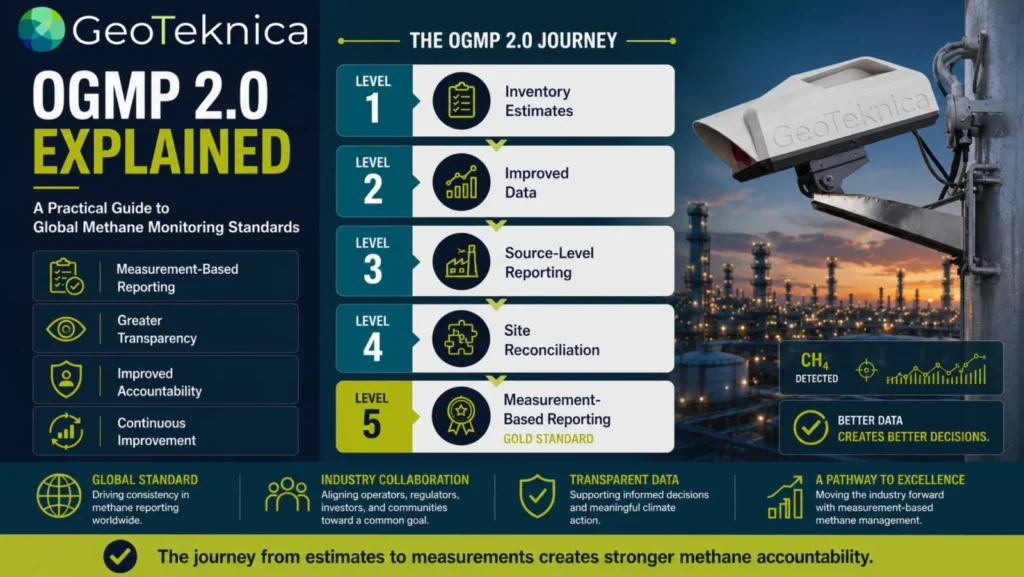
This data can also support increasingly sophisticated methane management and reporting programs. The Oil & Gas Methane Partnership 2.0 (OGMP 2.0), for example, places increasing emphasis on measurement, source-level quantification and site-level measurement reconciliation as companies move toward its highest reporting levels (OGMP 2.0, 2022).
Finally, continuous monitoring can help operators use resources more strategically. Rather than relying solely on a fixed inspection schedule, teams can use alerts and historical data to prioritize investigations based on actual conditions and risk.
Periodic Surveys: An Alternative Approach
Periodic surveys involve scheduled inspections and measurements of methane emissions. These surveys may use technologies such as optical gas imaging, portable methane detectors, Method 21 instruments, mobile monitoring systems or other specialized equipment.
Periodic surveys remain an important component of methane management. They can provide detailed information about individual components and are particularly useful for locating and characterizing the source of a detected emission. They are also familiar to many operators and can be incorporated into established leak detection and repair programs.
However, the fundamental limitation is straightforward: a periodic survey is a snapshot in time.
If a facility is inspected once every three months, for example, the survey provides detailed information about conditions during that inspection. It does not necessarily tell operators what happened during the other 89 days.
This does not make periodic surveys ineffective. Rather, it highlights the importance of understanding what information they can, and cannot, provide.
Limitations of Periodic Surveys
The primary limitation of periodic surveys is the potential gap between the occurrence of an emission and its discovery. If a leak begins shortly after an inspection, it may remain undetected until the next scheduled survey.
That gap can become particularly important for intermittent emissions. An emission that occurs only under certain operating conditions may not be present when an inspector arrives at the site. The equipment can therefore pass an inspection while still experiencing emissions at other times.
This challenge is increasingly relevant as the industry develops a more measurement-informed understanding of methane emissions. The IEA’s 2025 Global Methane Tracker notes that satellite and measurement data have improved understanding of methane emissions, while also identifying significant remaining data gaps. The agency also reports that around one-quarter of emissions sources identified in one global analysis of oil and gas methane plumes were recurrent, meaning emissions were detected repeatedly at the same location (IEA, 2025).
Periodic surveys can also require significant coordination and personnel time, particularly across large or geographically dispersed operations. Each inspection represents a specific point in time and requires personnel and equipment to be deployed to the site.
Environmental and operating conditions can introduce another variable. Wind, temperature, terrain and other factors can affect methane dispersion and detection. A survey may therefore be influenced by conditions that differ from those present when an emission initially occurred.
These limitations do not mean that periodic surveys should be abandoned. In fact, they highlight why a layered monitoring strategy can be more effective than relying on a single technology. Continuous monitoring can provide persistent surveillance and alerts, while periodic surveys and other high-resolution technologies can be used to locate, investigate and quantify emissions.
The Case for Always-On Detection
Given the limitations of periodic surveys, always-on detection systems present a compelling case for organizations looking to strengthen their methane management programs.
The strongest argument for continuous monitoring is not necessarily that it should replace every existing monitoring method. Rather, it is that continuous systems can fill the gaps that periodic surveys inherently leave behind.
A periodic survey tells an operator what was happening when the survey occurred. An always-on system can provide a much broader operational history.
That distinction becomes especially valuable when dealing with unpredictable or intermittent emissions. If an emission begins at 2 a.m. on a Sunday, for example, a continuous monitoring system can identify the change regardless of the inspection schedule. The operator can then investigate the event rather than waiting for the next planned survey.
The broader monitoring ecosystem is also evolving beyond fixed sensors. Satellite-based systems, aerial surveys, mobile monitoring and other advanced technologies are increasingly being used to identify methane emissions across larger areas. UNEP’s Methane Alert and Response System (MARS), for example, combines information from more than 30 satellite instruments with advanced data analysis to identify and communicate significant methane emissions to governments and companies (UNEP, 2026).
At the same time, satellites and other remote technologies have their own limitations, including detection thresholds and challenges associated with clouds, sunlight, terrain and certain geographic conditions. UNEP explicitly notes that satellite monitoring is not a silver bullet.
This reinforces an important point: the future of methane monitoring is unlikely to be one technology replacing another. It is more likely to be an integrated system in which different technologies perform different roles.
Always-on detection can provide the persistent layer. Periodic surveys can provide detailed inspection and verification. Aerial and satellite technologies can provide broader facility or regional coverage. Together, these tools can provide a more complete understanding of methane emissions than any single approach can provide alone.
Enhancing Sustainability and Compliance
Always-on detection can strengthen both environmental performance and operational decision-making by making methane emissions more visible and actionable.
Continuous data can help companies identify recurring problem areas, prioritize maintenance and assess whether mitigation measures are working as intended. Instead of treating methane inspections as isolated compliance activities, operators can begin to view monitoring as part of an ongoing performance-management process.
This approach also aligns with the broader movement toward measurement-informed emissions reporting. OGMP 2.0’s highest reporting level, Level 5, incorporates site-level measurements to reconcile site-wide emissions with source-level estimates. The framework recognizes that measurement technologies can help provide an independent assessment of emissions across an entire facility or site (OGMP 2.0, 2022).
Regulatory frameworks are evolving in a similar direction. In the United States, the EPA has established pathways for advanced methane detection technologies, including continuous monitoring, to be evaluated as alternative methods for certain regulatory applications. The agency’s current program includes technologies for periodic screening, continuous monitoring and super-emitter detection (U.S. EPA, 2026).
Beyond compliance, continuous monitoring can support better operational decision-making. Historical data can reveal patterns that would otherwise be difficult to see, allowing operators to focus resources where they are likely to have the greatest impact.
There is also a practical economic argument. Methane is a valuable product, and an emission represents lost product as well as an environmental impact. The IEA estimates that around 25 million tonnes of upstream methane emissions could have been avoided in 2024 at no net cost, while many other mitigation opportunities offer positive economic returns (IEA, 2025).
The opportunity, therefore, is not simply to detect more methane. It is to detect it earlier, understand it better and respond more effectively.
Conclusion
In the context of methane monitoring, the choice between continuous monitoring and periodic surveys does not have to be an either-or decision. Both approaches have an important role to play, but they provide fundamentally different types of information.
Periodic surveys remain valuable for detailed inspections, source identification and verification. However, they are inherently limited by their frequency. Emissions can begin, stop or change between inspections, and intermittent events may never occur during a scheduled survey.
Always-on monitoring addresses this information gap by providing continuous visibility into changing conditions. It can help operators detect unexpected events sooner, identify recurring emissions, verify repairs and build a more complete understanding of how emissions behave over time.
As methane management becomes increasingly measurement-driven, this continuous visibility is likely to become more valuable. The most effective monitoring programs will not necessarily rely on a single technology. Instead, they will combine continuous sensors, periodic surveys, mobile measurements, aerial monitoring and satellite observations according to the characteristics and risks of each operation.
Ultimately, the goal is not simply to know how much methane a facility emits. It is to know where, when, why and for how long those emissions occur. Most importantly it is to have the information needed to do something about them. Always-on detection is an important step toward making that possible.
References:
International Energy Agency (IEA). (2025). Global Methane Tracker 2025.
https://www.iea.org/reports/global-methane-tracker-2025
International Energy Agency (IEA). (2026). Global Methane Tracker 2026.
https://www.iea.org/reports/global-methane-tracker-2026
Oil & Gas Methane Partnership 2.0 (OGMP 2.0). OGMP 2.0 Reporting Framework.
https://ogmpartnership.com/wp-content/uploads/2023/02/OGMP_20_Reporting_Framework.pdf
United Nations Environment Programme (UNEP). Methane Alert and Response System (MARS).
https://www.unep.org/topics/energy/methane/methane-alert-and-response-system-mars
U.S. Environmental Protection Agency (EPA). Oil and Gas Alternative Test Methods.
https://www.epa.gov/emc/oil-and-gas-alternative-test-methods