Leak Detection and Repair: Best Practices for Smarter Methane Control
Methane leaks can be surprisingly easy to miss.
A valve may appear to be operating normally. A flange can look completely intact. A compressor seal may show no obvious sign of trouble. Yet somewhere within a complex oil and gas facility, methane can be escaping into the atmosphere without being visible to the naked eye.
That is why an effective Leak Detection and Repair program is about more than simply finding leaks. It is about building a reliable process for identifying emissions, responding quickly, repairing the underlying problem, and verifying that the repair worked.
For operators, Leak Detection and Repair has traditionally relied on periodic inspections using technologies such as optical gas imaging and EPA Method 21. Today, continuous monitoring technologies are adding another layer of visibility, allowing operators to identify changing conditions between scheduled surveys.
The most effective approach is not necessarily choosing one technology over another. Instead, combining different tools to provide more coverage, faster response, and better information about where emissions are occurring.
What Is Leak Detection and Repair?
At its core, Leak Detection and Repair is a systematic process for finding and addressing unintended emissions from equipment and components. Oil and gas facilities contain thousands of potential emission points, including valves, connectors, compressors, pumps, and other components. Over time, seals can degrade, connections can loosen, equipment can become damaged, and operating conditions can change.
A Leak Detection and Repair program provides a structured way to identify these problems before they become larger sources of emissions. The process generally involves three steps: detection, repair, and verification.
First, operators conduct inspections using an appropriate detection technology. When a leak is identified, the component is documented and prioritized for repair. After the repair is completed, the component should be checked again to confirm that the source has been addressed. This final step is particularly important. Finding a leak is only useful if the information leads to action, we will come back to this.
The U.S. Environmental Protection Agency has long recognized Leak Detection & Repair as an important tool for controlling fugitive emissions, and its guidance describes practices for improving the effectiveness of LDAR programs (U.S. Environmental Protection Agency [EPA], 2007).
Optical Gas Imaging: Seeing What Cannot Be Seen
Optical gas imaging has become one of the most recognizable technologies used in Leak Detection and Repair programs.
An OGI camera uses infrared technology to visualize certain gases that cannot be seen with the human eye. Instead of relying solely on a numerical concentration reading, an operator can observe a gas plume and trace it back toward its source.
Consider a facility with hundreds of valves and connections, a traditional inspection may require an operator to move from component to component using a handheld instrument. OGI provides another perspective by allowing trained personnel to scan equipment and observe emissions across a wider area.
The EPA recognizes OGI as a monitoring method for fugitive emissions from oil and natural gas operations. Current EPA requirements also establish specific conditions for using OGI, including equipment performance, operator procedures, and monitoring requirements (EPA, 2024).
However, OGI is not a perfect solution for every situation. Performance can be affected by factors such as wind, temperature, background conditions, viewing distance, equipment configuration, and operator experience. A camera can show that emissions are present, but the visual size of a plume does not necessarily tell an operator exactly how much methane is being released.
This is one reason LDAR programs benefit from using OGI alongside other measurement and monitoring approaches.
Continuous Monitoring Adds Another Layer
Periodic inspections provide valuable information, but they also create a fundamental limitation: there is time between inspections.
A leak that begins shortly after a scheduled survey may remain undetected until the next inspection. Depending on the component and the size of the emission, that gap can represent a significant amount of released methane. Continuous monitoring changes the timing of detection.
Rather than checking equipment only at scheduled intervals, continuous monitoring systems can observe methane concentrations or other indicators at much higher frequencies. When a system identifies an unusual concentration or emission event, operators can investigate the location and determine whether corrective action is necessary.
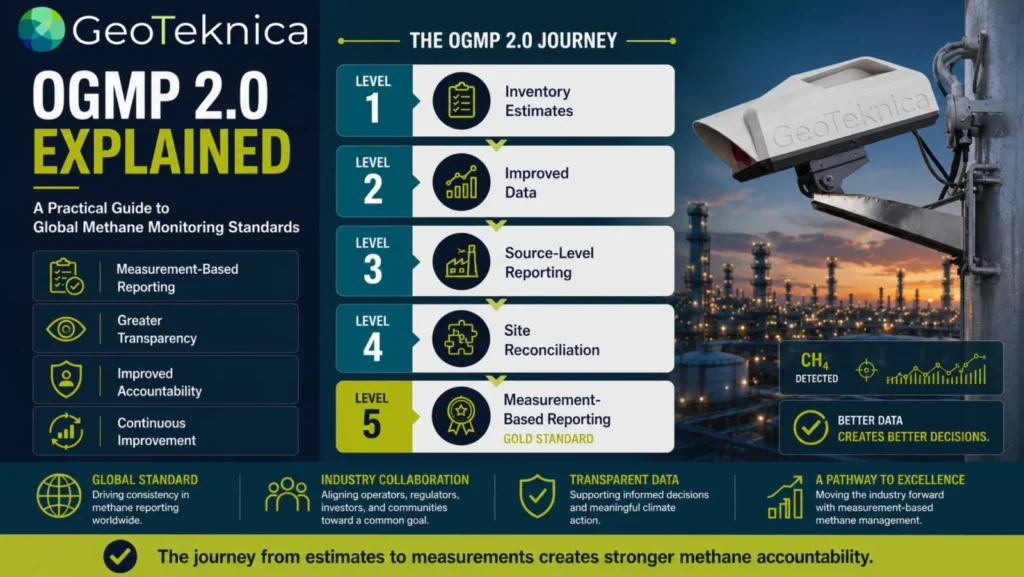
The Oil and Gas Methane Partnership 2.0 has highlighted continuous monitoring as a useful component of a broader, multi tiered methane measurement strategy. Its recommendations also emphasize that continuous monitoring should not automatically be treated as a standalone solution because different technologies have different capabilities and limitations (Oil and Gas Methane Partnership 2.0 [OGMP 2.0], 2024).
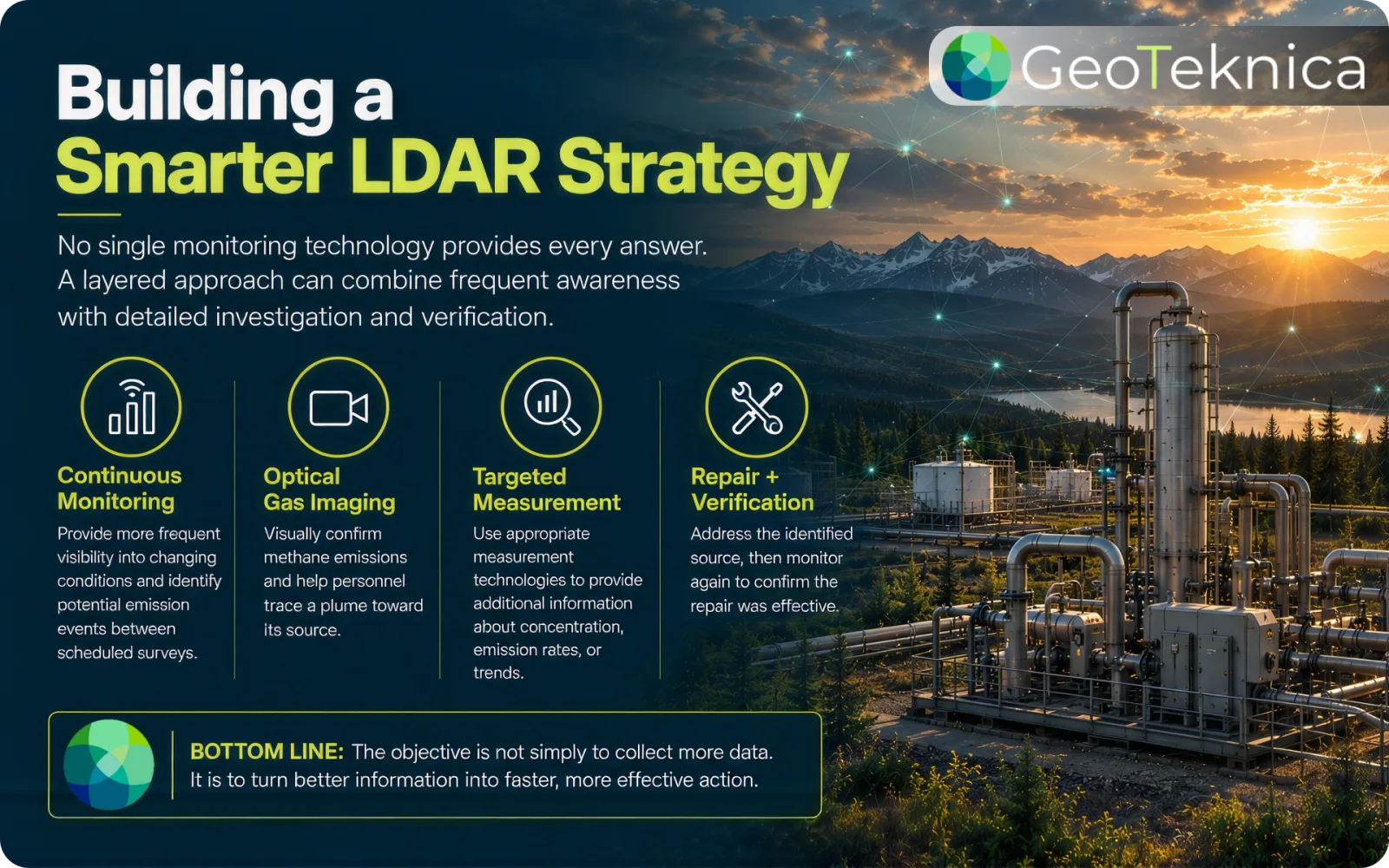
Continuous monitoring can provide the frequency that periodic surveys cannot. OGI can provide visual confirmation and help locate the source. Other measurement technologies can provide additional information about concentration, emission rates, or trends.
From Detection to Repair
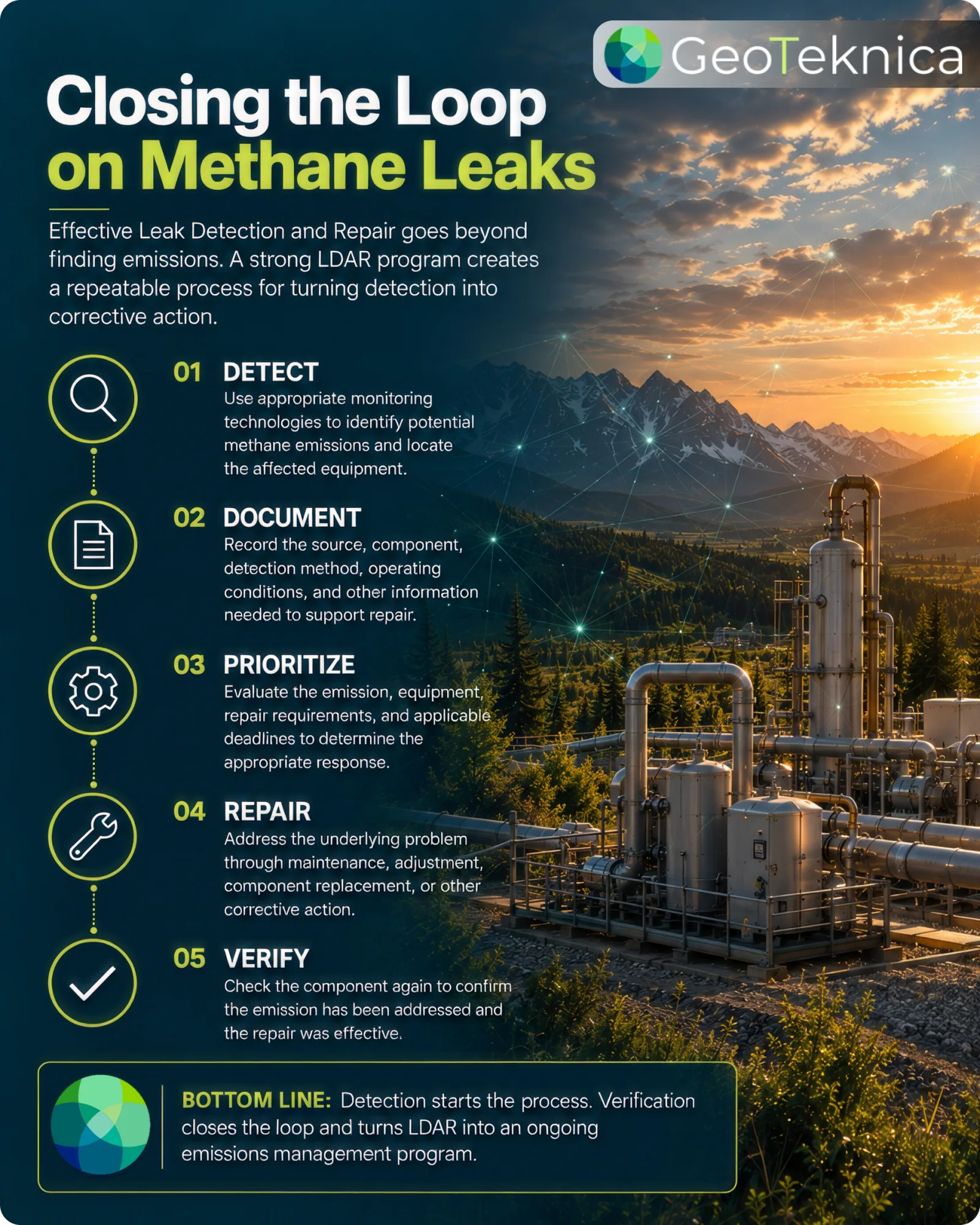
A strong Leak Detection and Repair program needs a clear process for what happens after a leak is identified. Without a defined response, even highly sophisticated monitoring technology can produce little practical benefit.
The first priority should be documentation. Operators should record where the leak was found, which component is involved, when it was detected, the detection method used, and any relevant operating conditions. Good records allow maintenance teams to understand exactly what needs attention and help operators identify recurring problems.
The next step is prioritization. Not every leak will have the same emission rate, operational risk, repair complexity, or regulatory deadline. A practical repair strategy considers the characteristics of the leak and the equipment involved so that resources can be directed where they can have the greatest impact.
The repair itself may be relatively simple. Tightening a connection, replacing a gasket, adjusting a valve, replacing a seal, or changing a damaged component can sometimes eliminate the source.
In other situations, repairs may require equipment isolation, specialized parts, or a planned shutdown. This is where having a documented Leak Detection & Repair procedure becomes particularly valuable.
The EPA’s guidance emphasizes the importance of identifying components that require repair, documenting repairs that cannot be completed during the initial survey, and conducting follow up monitoring to verify the repair (EPA, 2016).
Verification Closes the Loop
One of the easiest steps to overlook in Leak Detection & Repair is verification.
A component should not simply be marked as repaired because a technician worked on it. The result needs to be checked. For example, an operator may use OGI to confirm that the visible emission has stopped. In other circumstances, Method 21 or another appropriate measurement method may be used to determine whether the component continues to emit above the applicable threshold.
This creates a closed loop: Detect. Document. Repair. Verify. That loop is what turns Leak Detection and Repair from an inspection activity into an emissions management program.
Verification also creates useful operational data. If the same type of valve repeatedly develops leaks, that information can point toward a larger maintenance or equipment design issue. Over time, LDAR records can therefore become more than compliance documentation. They can become a source of information for improving equipment reliability and reducing recurring emissions.
Building a Smarter LDAR Strategy
There is no universal Leak Detection and Repair program that works identically for every facility. A large processing plant, a compressor station, and an upstream production site can have very different equipment configurations and operating conditions. Monitoring frequency, technology selection, repair procedures, and staffing should reflect those differences.
A practical strategy may combine scheduled OGI surveys with continuous monitoring at higher risk locations. Continuous systems can help identify potential emission events between surveys, while OGI can provide visual confirmation and assist with locating the source.
Operators can also use historical Leak Detection and Repair data to identify recurring problem areas and adjust inspection strategies accordingly.
This is where technology becomes particularly useful. The objective is not simply to collect more data. It is to turn better data into faster and more effective action.
Modern methane management is increasingly moving toward this type of integrated approach. The EPA now provides pathways for advanced methane detection technologies, including technologies designed for periodic screening and continuous monitoring, subject to applicable requirements and approvals (EPA, 2026).
The Goal Is Faster Action
The best Leak Detection and Repair program is not necessarily the one with the most sensors, the most inspections, or the largest amount of data. It’s the one that consistently turns detection into action.
Optical gas imaging provides an important visual tool for identifying emissions. Continuous monitoring can provide more frequent awareness of changing conditions. A well designed repair process ensures that detected leaks are addressed, documented, and verified.
Each technology has strengths and limitations. Used together, they can provide a more complete picture of methane emissions than any single approach can provide on its own. Ultimately, Leak Detection and Repair is about shortening the distance between an emission beginning and an operator knowing about it. The sooner a leak is detected, the sooner it can be investigated. The sooner it is repaired, the less time that emission has to continue.
For oil and gas operators, that is both an environmental opportunity and an operational one. Better detection can mean better maintenance information, fewer recurring problems, improved emissions visibility, and more informed decisions about where mitigation efforts can have the greatest impact.
Leak Detection and Repair is therefore evolving beyond the traditional idea of periodic leak surveys. It is becoming a more connected process that brings together imaging, continuous monitoring, measurement, maintenance, and verification. The technology may continue to change, but the underlying principle remains straightforward: find the leak, fix the leak, and make sure it stays fixed.
Learn how GeoTeknica can help with your methane management challenges today.
References
Oil and Gas Methane Partnership 2.0. (2024). OGMP 2.0 recommendations on continuous monitoring. United Nations Environment Programme.
https://ogmpartnership.com/wp-content/uploads/2024/07/OGMP20_Recommendations-CM_Final_20240425.pdf
U.S. Environmental Protection Agency. (2007). Leak Detection and Repair: A best practices guide.
https://www.epa.gov/compliance/leak-detection-and-repair-best-practices-guide
U.S. Environmental Protection Agency. (2016). Control techniques guidelines for the oil and natural gas industry.
https://www3.epa.gov/airquality/ctg_act/2016-ctg-oil-and-gas.pdf
U.S. Environmental Protection Agency. (2024). Frequently asked questions: Fugitive emissions.
https://www.epa.gov/controlling-air-pollution-oil-and-natural-gas-operations/frequently-asked-questions-fugitive
U.S. Environmental Protection Agency. (2026). Oil and gas alternative test methods.
https://www.epa.gov/emc/oil-and-gas-alternative-test-methods