Understanding Fugitive Emissions Cost: The Financial and Regulatory Impact of Missed Leaks

A small leak from a valve, connector, flange, compressor, storage vessel, or other component can continue releasing methane for days, weeks, or even months before it is discovered. During that time, the operator is losing valuable product. The leak can also create additional monitoring and repair requirements, complicate emissions reporting, increase regulatory exposure, and contribute to an emissions profile that becomes increasingly difficult to manage. At this moment, fugitive emissions cost becomes more than an environmental consideration, it becomes an operational and financial consideration.
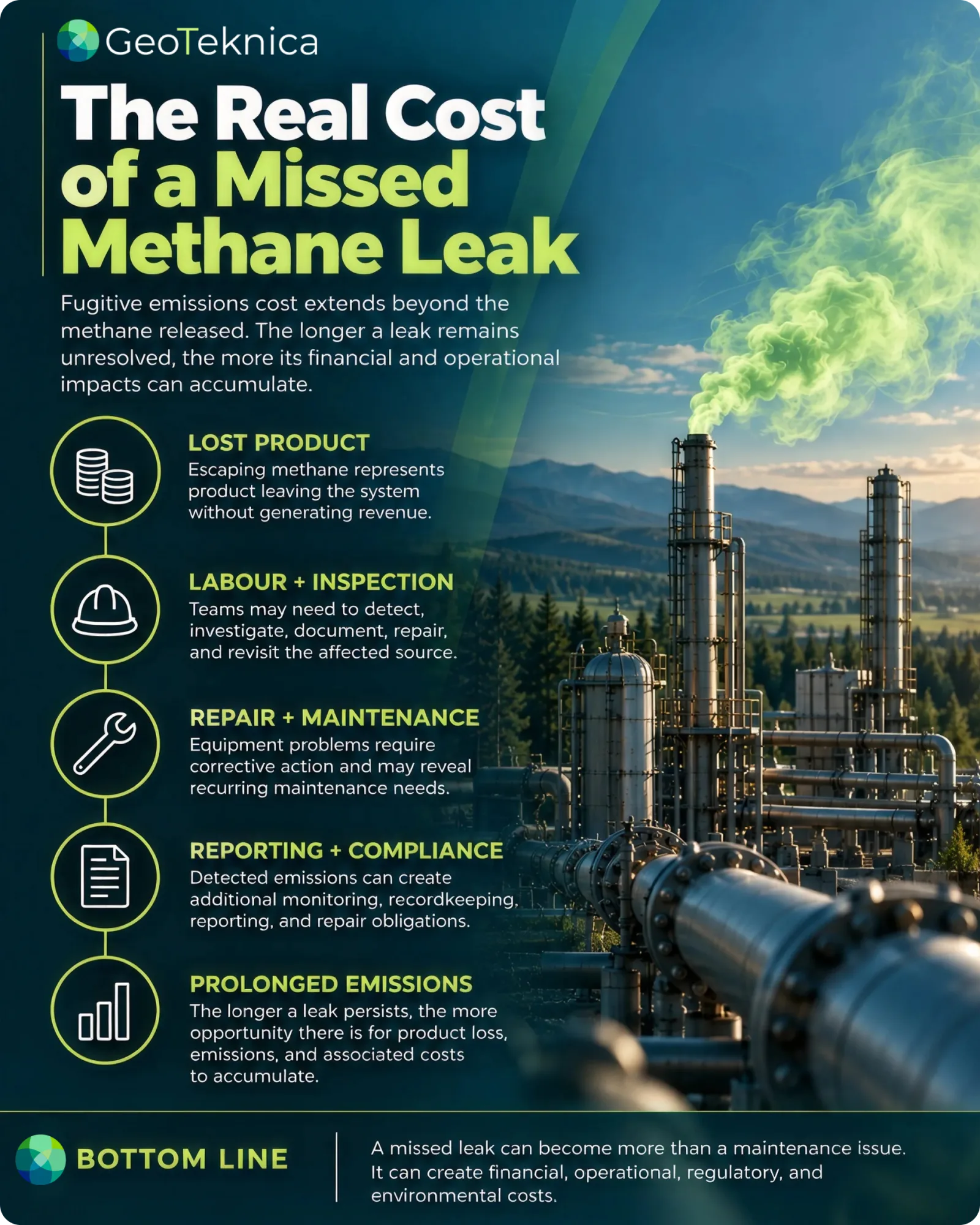
For oil and gas operators, understanding the fugitive emissions cost associated with an undetected leak means looking beyond the volume of methane released. The real cost can include lost product, increased labour and inspection, repairs, difficult reporting, tighter compliance, and the opportunity cost of allowing a problem to remain unresolved. The longer a leak goes undetected, the more those costs can accumulate.
The Financial Cost Starts With Lost Product
At its most basic level, a methane leak represents product leaving the system without generating revenue. The financial impact depends on several factors, including the size and duration of the leak, the composition of the gas, and the market value of the recovered product. A leak that releases a relatively small amount of methane every hour may appear insignificant during a single inspection. Over weeks or months, however, the cumulative loss can become meaningful. This is one of the most important aspects of fugitive emissions cost because the gas being emitted has economic value.
The International Energy Agency estimates that around 30% of methane emissions from fossil fuel operations could be reduced at no net cost under 2025 energy prices. In the oil and gas sector, many mitigation measures can effectively pay for themselves because the cost of preventing or capturing emissions is lower than the value of the gas recovered (International Energy Agency [IEA], 2026).
Instead of treating methane reduction strictly as an additional operating expense, operators can also consider whether they are spending money to prevent a loss of saleable product. In some cases, addressing the fugitive emissions cost may involve an investment that helps recover value that would otherwise be lost.
A Missed Leak Can Become an Operational Cost
The financial impact does not end with the gas itself. Once a leak is identified, someone has to investigate it, determine the source, assess the equipment, schedule the repair, document the work, and potentially return to the site to verify that the repair was successful. When leaks are discovered through periodic surveys, there can be a significant amount of time between the beginning of an emission and the moment it enters the operator’s workflow. That delay is an aspect of determining fugitive emissions cost.
Consider two otherwise identical leaks. The first is detected shortly after it develops. The second remains undetected for several months. The physical repair may ultimately be similar, but the second leak has had more time to release product and create additional work. This is why measuring the cost of fugitive emissions requires more than looking at repair invoices. The cost of the leak begins before anyone arrives with a wrench and continues until the issue is dealt with.
Regulatory Requirements Are Changing the Equation
The regulatory environment surrounding methane emissions is also becoming increasingly focused on detection, measurement, reporting, and repair.
In the United States, EPA requirements include fugitive emissions monitoring and repair provisions for applicable oil and natural gas operations. Depending on the facility and equipment involved, requirements can include audio and visual inspections, optical gas imaging, or Method 21 monitoring. EPA also defines fugitive emissions components broadly, including equipment such as valves, connectors, pressure relief devices, flanges, compressors, meters, and other components. Essentially anything with the potential to emit methane or VOCs can be considered a risk (U.S. Environmental Protection Agency [EPA], 2024).
Separately, EPA’s Subpart W reporting framework requires applicable facilities to collect and calculate greenhouse gas emissions and follow specified procedures for reporting and recordkeeping. Recent updates have placed additional emphasis on improving the accuracy of methane emissions reporting and incorporating advances in measurement technology (EPA, 2026).
A leak is no longer simply something that needs to be found and repaired when convenient. Depending on the jurisdiction and facility, the operator may also need to demonstrate that monitoring requirements were followed and emissions were appropriately documented. Further EPA’s requirements establish specific repair timelines for certain fugitive emissions detected through applicable monitoring methods (EPA, 2024). The specific requirements vary by jurisdiction and facility, but the direction is clear: better emissions data is becoming an increasingly important part of methane management.
Detection Frequency Matters
Traditional leak detection and repair programs remain an important part of emissions management. However, periodic surveys inherently create gaps between inspections. A survey can tell an operator what is happening when the survey takes place. It cannot necessarily tell them what happened immediately after the inspection or what will happen before the next one.
A component can develop a leak at any time, including shortly after it has been inspected. If the next inspection is weeks or months away, the leak may continue operating outside the normal maintenance cycle. When we are discussing fugitive emissions cost it is essential to also consider the frequency at which sites are being checked.
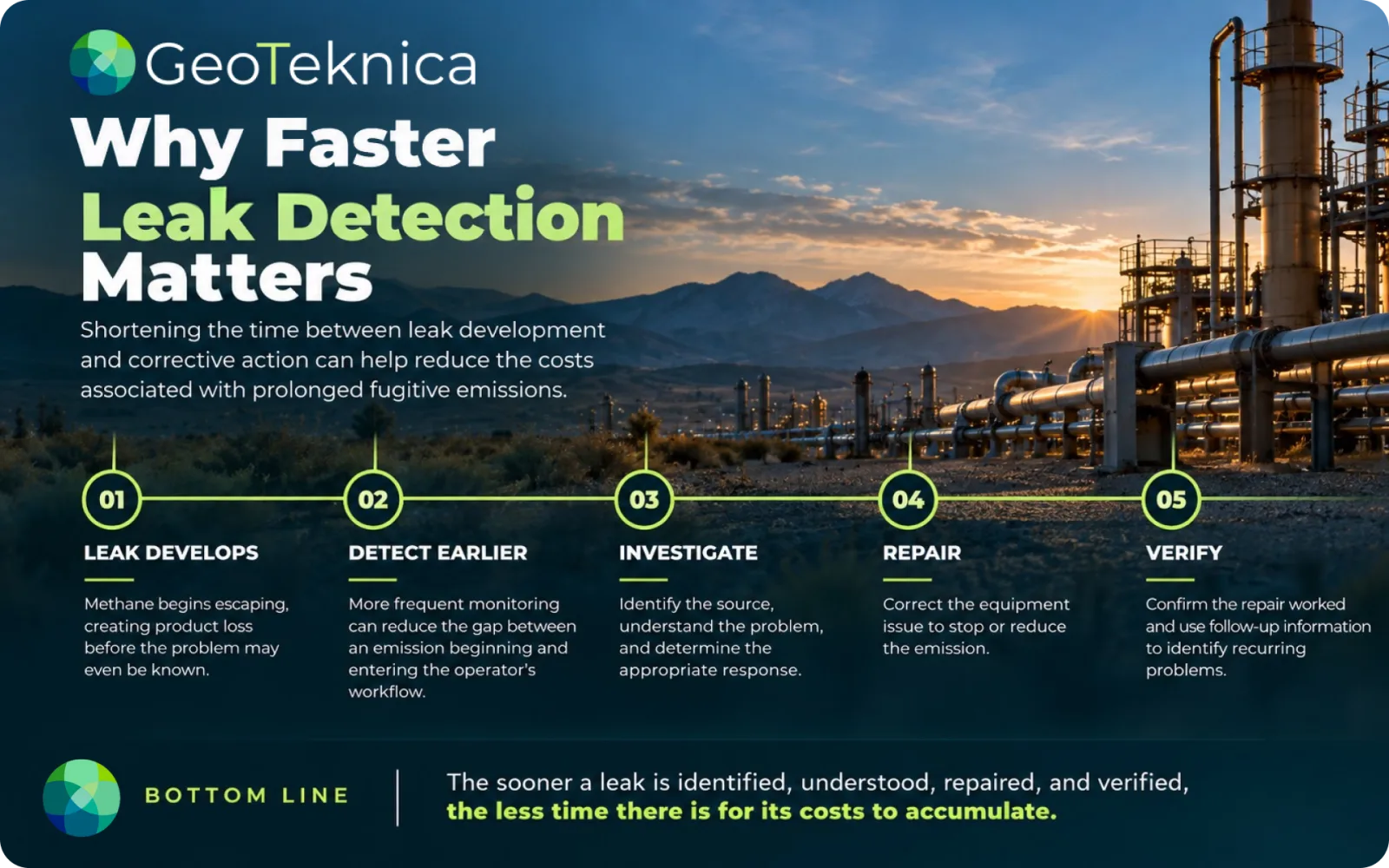
Continuous monitoring approaches can reduce that gap by providing more frequent information about changing conditions. Rather than relying entirely on scheduled inspections, operators can receive information when an abnormal emission occurs and potentially begin investigation sooner. The value of continuous monitoring is therefore not simply that it detects methane. Its value can come from reducing the amount of time between leak development, detection, investigation, and repair. In financial terms, shortening that timeline can reduce the fugitive emissions cost associated with prolonged leaks.
Continuous monitoring does not necessarily replace every other detection method. Different technologies provide different information, coverage, sensitivity, and operational advantages. Periodic inspections with handheld instruments, aerial surveys, satellites, and continuous systems can all have roles within a broader methane management program. The IEA identifies leak detection and repair among the established measures available to reduce methane emissions from oil and gas operations (IEA, 2026).
The objective is not to choose one tool for every situation. It is to build a detection strategy that gives operators useful information at the right time.
Repair Is Where Detection Creates Value
Finding a leak is only the first step, the financial and environmental value of detection is ultimately tied to what happens afterward. A useful leak management strategy connects detection with investigation, prioritization, repair, and verification. This allows operators to focus resources on the leaks that require attention while maintaining records that demonstrate how identified emissions were addressed.
For example, a monitoring system may identify an emission from a component that requires immediate investigation. The operator can then determine what the source is and being the repair process. Once repaired, follow up monitoring can help confirm that the emission has been reduced or eliminated. EPA guidance and requirements include repair and follow up provisions for detected fugitive emissions, reinforcing the importance of connecting detection with corrective action (EPA, 2024).
This process creates a feedback loop: Detect → Investigate → Repair → Verify
This feedback loop can also generate useful operational information. If certain components repeatedly develop leaks, that pattern may point toward equipment selection, maintenance practices, operating conditions, or other underlying issues that should be investigated. Over time, that information can help operators move from simply repairing individual leaks toward preventing recurring problems.
The Cost of Waiting
One of the biggest challenges with fugitive emissions cost is that it can be easy to underestimate. A leak rarely arrives with a single invoice labelled “total cost.” Instead, the impact is distributed across several parts of an operation. There may be lost product, inspection and detection cost, labour required to investigate and repair the source. There may also be additional monitoring or verification required all while ensuring proper reporting and recordkeeping. The longer the leak persists, the more opportunities there are for those individual costs to accumulate.
Additionally there is the environmental impact associated with methane released into the atmosphere. The IEA’s latest analysis estimates that the energy sector emitted nearly 150 million tonnes of methane in 2025, with oil operations accounting for approximately 44 million tonnes and natural gas activities for close to 34 million tonnes (IEA, 2026). The agency also estimates that many existing oil and gas abatement measures can be implemented at relatively low cost, with some opportunities having a positive economic return because recovered methane has market value (IEA, 2026).
A single missed leak may not change an operator’s overall emissions profile dramatically. But across thousands of components and multiple facilities, small leaks can become a significant source of lost product and emissions. That is why understanding fugitive emissions cost at the individual component level can help inform larger operational decisions.
Turning Leak Detection Into a Financial Strategy
Methane management is increasingly moving toward a model where emissions data supports operational decision making. Instead of asking only, “Do we have a leak?” operators can ask more useful questions. Questions can vary from how large the leak is to what the applicable regulatory requirements are. Deciding which detection or monitoring approach provides the information needed to answer those questions reliably is another multilevel question. However asking and answering these questions is what helps put fugitive emissions cost into an operational context.
The goal is not necessarily to monitor everything in exactly the same way. Different facilities have different risk profiles, equipment inventories, regulatory requirements, and operating conditions. A practical strategy can combine scheduled LDAR programs with additional monitoring technologies where continuous or more frequent information provides meaningful value.The result is a more informed approach to prioritizing maintenance and allocating resources.
The Real Cost of a Missed Leak
Ultimately, the fugitive emissions cost of a leak is about more than methane released into the atmosphere. It can represent product that could have been sold, labour that could have been avoided, equipment that may require additional attention, reporting obligations that need to be met, and emissions that could have been prevented.
The IEA’s analysis reinforces the economic case for addressing methane. Many available mitigation measures are already technically proven, and a significant share can be implemented at no net cost under current energy price assumptions due to the value of recovered (IEA, 2026). For operators, that means methane management does not have to be viewed solely through the lens of compliance or environmental performance. It can also be considered part of good asset management.
The most effective strategy will vary from facility to facility, but the underlying principle is straightforward: the sooner a leak is identified, understood, repaired, and verified, the less time there is for its costs to accumulate. A leak that is found quickly is a maintenance problem but a leak that remains invisible for months can become a financial, operational, regulatory, and environmental problem.
Understanding fugitive emissions cost is therefore not just about calculating what was lost. It is about recognizing the value of finding problems early and building leak detection and repair strategies that make that possible.
If you are interesting in continuous monitoring devices check out GeoTeknica for more information.
References
International Energy Agency. (2026). Global Methane Tracker 2026. International Energy Agency. https://www.iea.org/reports/global-methane-tracker-2026
International Energy Agency. (2026). Understanding methane emissions: Global Methane Tracker 2026. International Energy Agency. https://www.iea.org/reports/global-methane-tracker-2026/understanding-methane-emissions
U.S. Environmental Protection Agency. (2026). Methane Emissions Reduction Program and GHGRP Subpart W (Petroleum and Natural Gas Systems). https://www.epa.gov/inflation-reduction-act/methane-emissions-reduction-program-and-ghgrp-subpart-w-petroleum-and
U.S. Environmental Protection Agency. (2024). Frequently Asked Questions: Fugitive Emissions. https://www.epa.gov/controlling-air-pollution-oil-and-natural-gas-operations/frequently-asked-questions-fugitive