EU Methane Regulation Oil Gas: What North American Producers Need to Know
For North American oil and gas producers, regulatory developments in Europe may not seem immediately relevant. After all, the rules governing production in Alberta, British Columbia, Texas, or Pennsylvania are not the same as those governing operations in the European Union. But the energy market is increasingly interconnected, and regulation can travel through supply chains.
The European Union’s Methane Regulation is a good example. Although much of the regulation applies to activity within the EU, its requirements for imported oil and natural gas could have meaningful implications for producers outside Europe. For companies supplying European customers, methane measurement, reporting, verification, and intensity are becoming increasingly important considerations.
The EU methane regulation oil gas connection is therefore worth understanding now, particularly for North American producers that participate in international markets.
What Is the EU Methane Regulation?
Regulation (EU) 2024/1787 is the European Union’s framework for reducing methane emissions in the energy sector. It establishes requirements around the measurement, quantification, monitoring, reporting, and verification of methane emissions associated with oil, natural gas, and coal (European Union, 2024).
The regulation also addresses methane leaks, venting, and flaring within the EU. More importantly for international producers, it establishes requirements related to fossil fuels imported into the European market. However, its important to note that these regulation are progressively becoming relevant to North American producers.
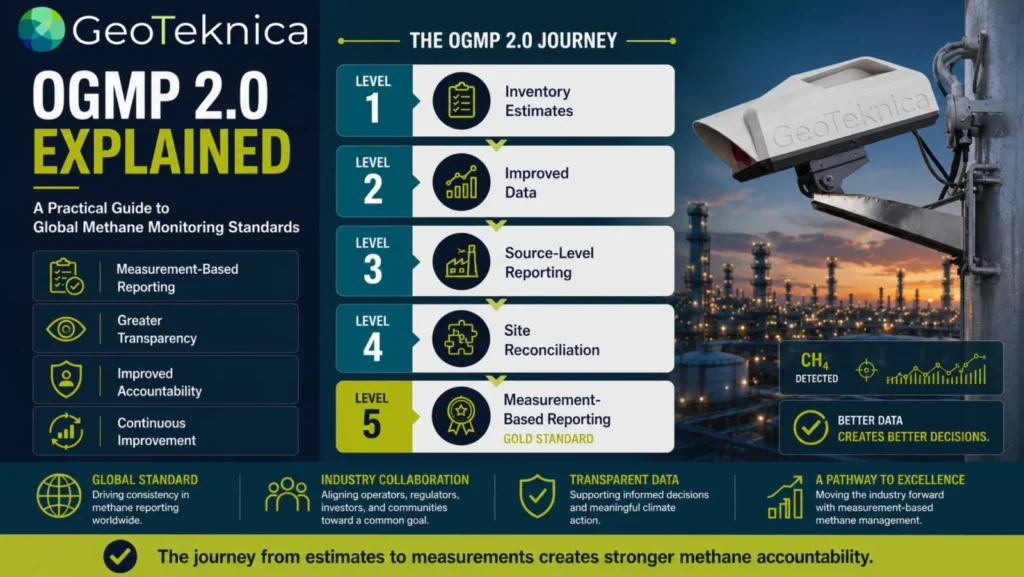
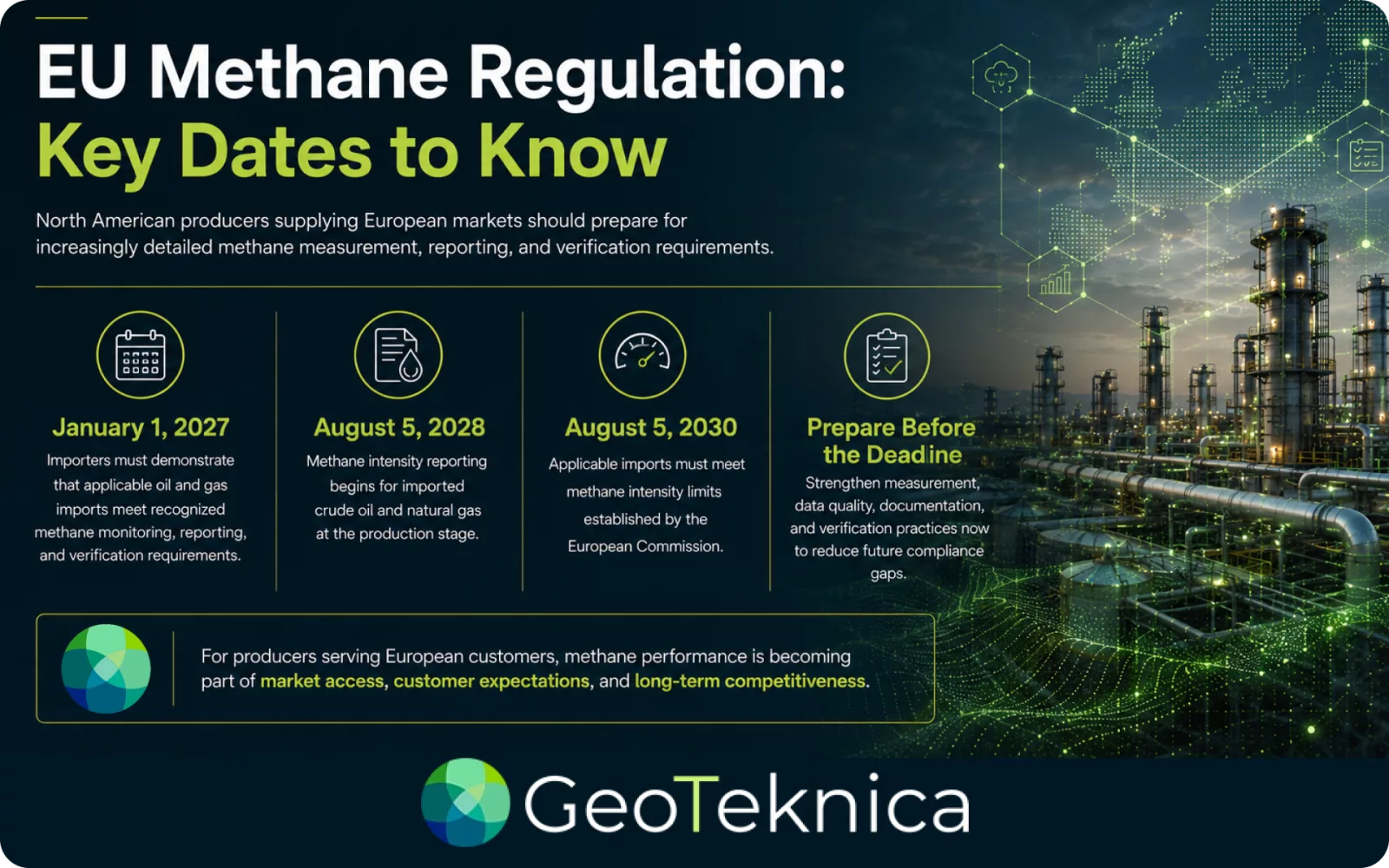
Starting January 1st, 2027, EU importers will need to demonstrate that imported crude oil, natural gas, or coal was produced in a jurisdiction with monitoring, reporting, and verification requirements equivalent to those applied within the EU. For oil and gas, production can also meet this requirement through the Oil and Gas Methane Partnership 2.0 Level 5 framework combined with verification (European Commission, 2026). For producers that sell into Europe, understanding these requirements early could make the difference between being prepared for a changing market and reacting to it later.
EU Methane Regulation Oil Gas and Why North American Producers Should Pay Attention
The most important issue is not simply the regulation itself. It is what the regulation means for the information that producers may need to provide to customers.
Beginning August 5th, 2028, importers will be required to report the methane intensity associated with imported crude oil, natural gas, and coal at the production stage. From August 5th, 2030, importers will need to demonstrate that imported fossil fuels meet a methane intensity limit established by the European Commission. These requirements apply to contracts signed or renewed after the relevant dates, with additional provisions for certain pre existing contracts (European Commission, 2026). That creates a growing commercial incentive for producers to understand their methane performance and have reliable data to support it.
For North American companies, this could mean taking a closer look at how methane emissions are measured across facilities, how estimates are calculated, how data is documented, and whether information can be independently verified. The EU methane regulation oil gas issue is therefore not simply a European compliance matter. For producers participating in the European market, it can become part of the broader conversation around market access, customer requirements, and demonstrating the characteristics of a product.
Data Is Becoming Increasingly Important
One of the most significant developments in methane management is the shift toward more detailed and reliable emissions data.
For years, oil and gas companies have collected enormous amounts of operational information. Production volumes, equipment performance, maintenance records, environmental monitoring, and safety information can all provide valuable insight into how an operation is performing. Methane data not only fits into that larger picture, it helps create it and its time to use it effectively. Better measurement can help companies understand where emissions are occurring, identify equipment that may require attention, and determine whether mitigation efforts are producing measurable results. It can also provide customers and regulators with greater confidence in reported information.
The International Energy Agency’s Global Methane Tracker 2026 notes that the energy sector accounts for around 40% of methane emissions from human activity and identifies the sector as having significant opportunities to reduce those emissions. The report also highlights the growing development of markets for fuels with near zero methane intensity (International Energy Agency [IEA], 2026).
This makes reliable measurement increasingly valuable. Data can support regulatory requirements, help producers make better immediate operational decisions and guide future decisions. The European Commission similarly emphasizes that detecting and quantifying methane emissions is a fundamental part of reducing them. Its regulation therefore places significant emphasis on measurement, reporting, and verification (European Commission, 2026).
Compliance and Operational Efficiency Can Work Together
Environmental performance and operational performance are not always separate conversations.
Methane is a valuable component of natural gas. When methane escapes through leaks, venting, or equipment designed in ways that release methane during normal operation, there can be both an environmental impact and a potential loss of product.
The IEA identifies a range of established opportunities for reducing methane emissions from oil and gas operations and notes that many available measures can be implemented using existing technologies (IEA, 2026). For producers, this creates an opportunity to approach the EU methane regulation oil gas requirements from a practical perspective. Instead of viewing every new requirement as a standalone regulatory burden, companies can consider whether the underlying data collection and emissions management practices can also improve operational visibility.
Finding a leak sooner can reduce emissions. It can also prevent the loss of a valuable product.
That is an important distinction. Effective methane management does not have to be framed solely as an environmental initiative or solely as a compliance exercise. In the right circumstances, it can support environmental performance, operational efficiency, resource conservation, and market readiness at the same time.
What Should Producers Be Doing Now?
The first step is understanding where the company currently stands.
Producers that supply, or may eventually supply, European customers should review their existing methane measurement and reporting practices. That review does not necessarily require a complete overhaul of existing systems. It should begin with a clear understanding of what information is already available and where gaps may exist.
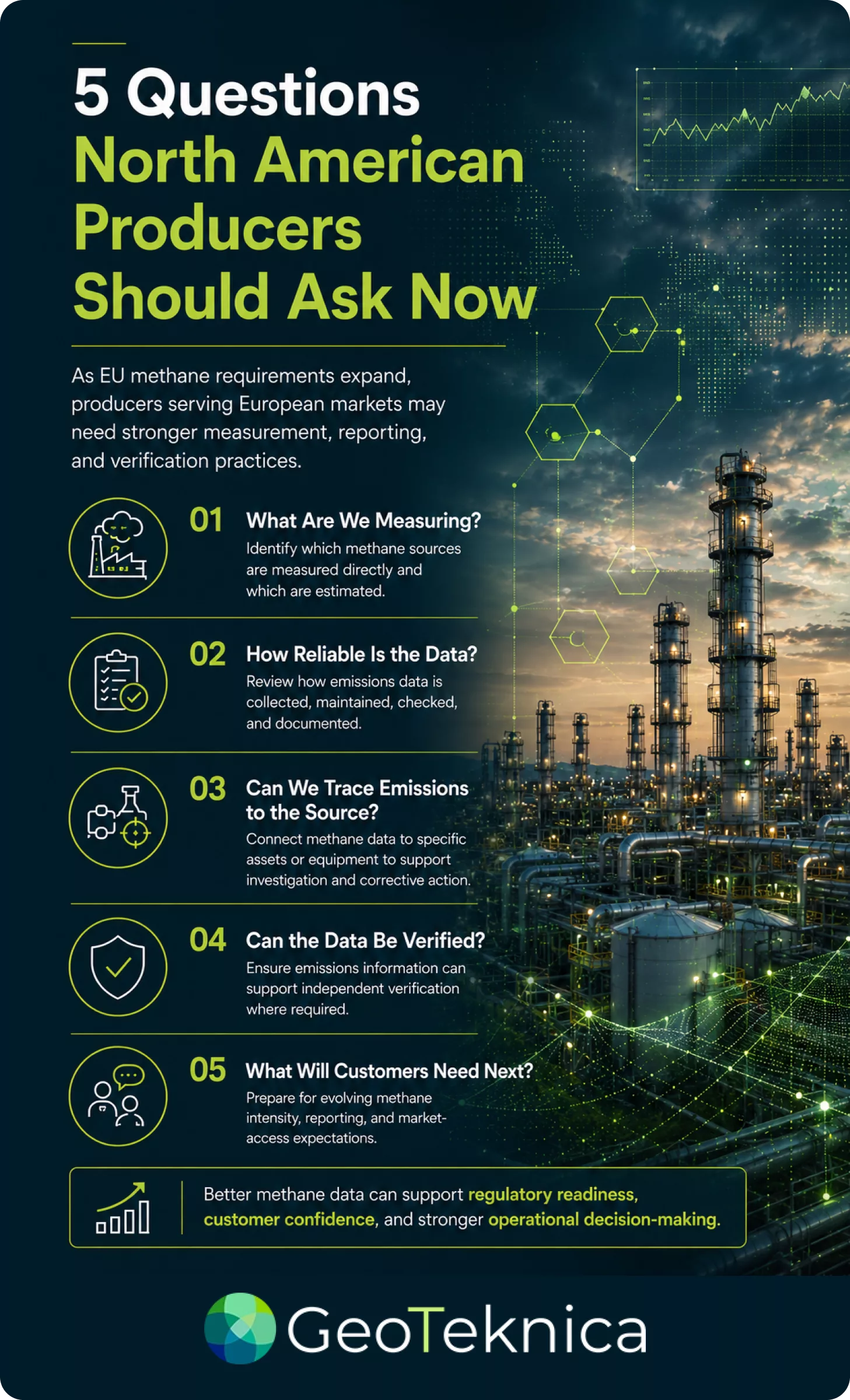
Five questions are worth asking:
1. What methane sources are currently being measured?
A company cannot effectively manage what it cannot see. Understanding which sources are measured directly and which are estimated is an important starting point.
2. How reliable is the existing data?
Data quality matters. Producers should understand how measurements are collected, maintained, checked, and documented.
3. Can emissions be connected to specific assets or sources?
More detailed information can make it easier to identify recurring issues and prioritize corrective action.
4. Can the information be independently verified?
As reporting requirements become more rigorous, verification can become increasingly important for demonstrating the credibility of emissions data. The EU framework specifically incorporates independent verification into its approach to methane measurement and reporting (European Commission, 2026).
5. What information might customers need in the future?
Producers should consider not only today’s requirements but also where customer expectations and international regulations appear to be heading.
These questions can help companies identify practical gaps before they become commercial or regulatory challenges.
Preparing for a More Data Driven Energy Market
The EU methane regulation oil gas requirements are part of a broader movement toward greater transparency around emissions associated with energy production. That does not change the importance of oil and natural gas in today’s energy system. It does mean that producers are increasingly being asked to demonstrate how those resources are produced, measured, and managed. For North American producers, that creates both a challenge and an opportunity.
Companies that invest in reliable measurement and reporting can be better positioned to meet changing requirements. They may also gain a clearer understanding of their own operations, identify equipment issues sooner, reduce product losses, and make more informed decisions about where mitigation efforts can deliver the greatest value.
The European market is one example of where these expectations are developing, but the underlying principle is broader. Good environmental data supports good operational decisions.
The Time to Prepare Is Now
The EU’s requirements for imported oil and natural gas are being introduced over several years, giving producers time to understand what will be required and evaluate their existing capabilities.
The timeline is already underway. Importers have had reporting obligations in place since May 2025, while the next major milestone arrives January 1, 2027, when importers must demonstrate that imported oil and gas meets the applicable monitoring, reporting, and verification requirements. Methane intensity reporting follows in August 2028, with methane intensity requirements for certain contracts beginning in August 2030 (European Commission, 2026). For producers with European customers, that timeline provides an opportunity rather than a reason to wait.
Understanding current methane performance, strengthening data quality, reviewing measurement practices, and identifying practical opportunities for emissions reduction can all help companies prepare for what is ahead.The EU methane regulation oil gas conversation ultimately comes down to something relatively straightforward: knowing what is happening in your operations and being able to demonstrate it.
For an industry operating in a global market, understanding upcoming international requirements is undeniably valuable.
References
European Commission. (2026). Methane emissions. Directorate General for Energy.
https://energy.ec.europa.eu/topics/carbon-management-and-fossil-fuels/methane-emissions_en
International Energy Agency. (2026). Global methane tracker 2026. IEA.
https://www.iea.org/reports/global-methane-tracker-2026
European Union. (2024). Regulation (EU) 2024/1787 of the European Parliament and of the Council of 13 June 2024 on the reduction of methane emissions in the energy sector and amending Regulation (EU) 2019/942. Official Journal of the European Union.
https://eur-lex.europa.eu/legal-content/EN/TXT/HTML/?uri=CELEX:32024R1787
EU Methane Regulation Oil Gas: What North American Producers Need to Know