EPA LDAR and the New Methane Rules: What Subpart W and OOOOb Mean for Facility Operations
Methane management is becoming less of a periodic environmental task and more of an ongoing part of facility operations. For oil and natural gas operators, that means the way emissions are detected, documented, repaired, and reported is increasingly connected to the way facilities are managed every day.
Two important pieces of the U.S. regulatory framework are the EPA’s Greenhouse Gas Reporting Program requirements under Subpart W and the emissions standards established under OOOOb. While these rules serve different purposes, together they are changing how operators approach emissions measurement, monitoring, documentation, and response.
For facility teams, the important question is not simply what the regulations require on paper. It is how those requirements translate into practical changes in the field.
Subpart W and OOOOb: Two Rules With Different Purposes
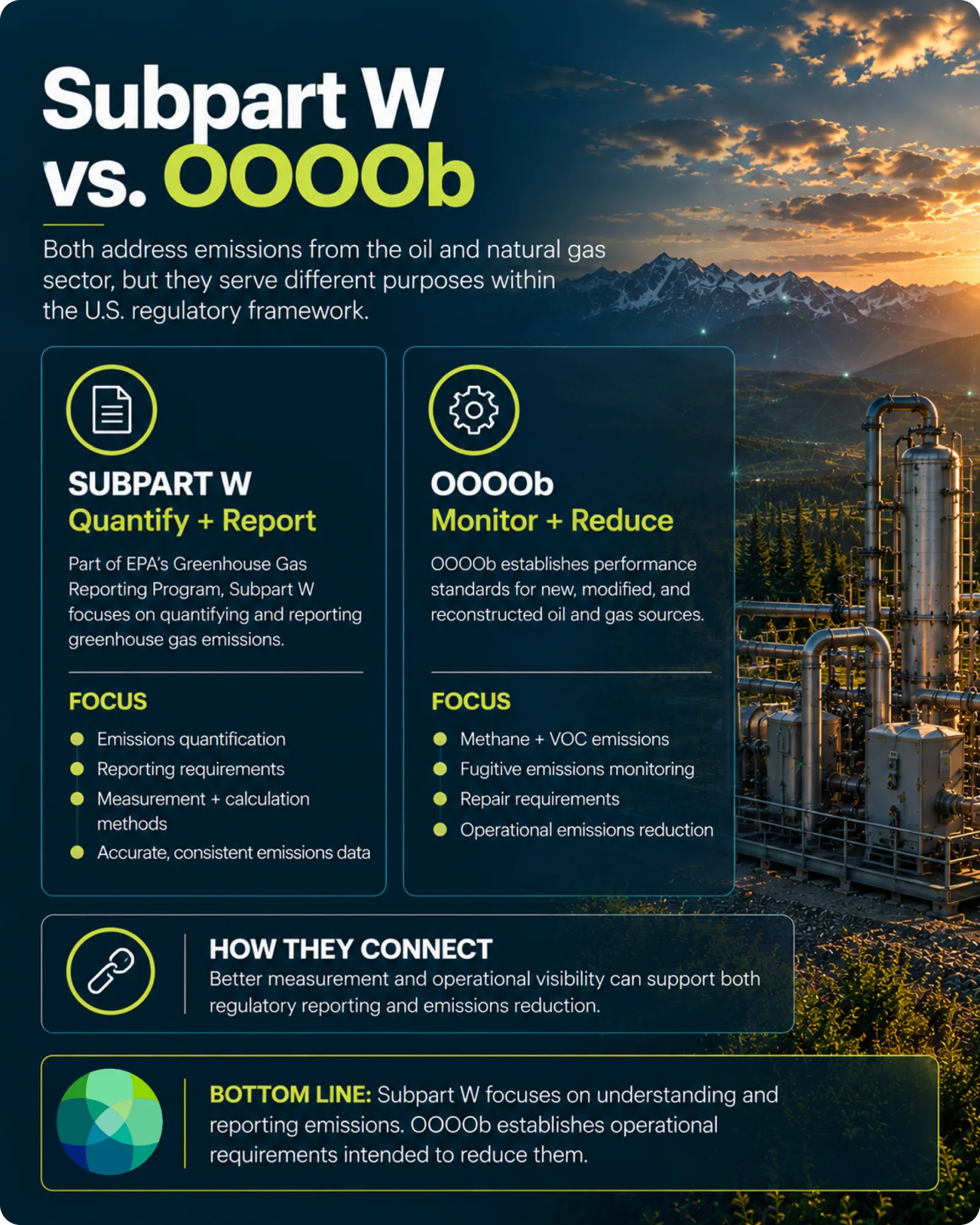
Subpart W and OOOOb are often discussed together because both address methane emissions from the oil and natural gas sector. However, they operate differently and place different demands on facility operators.
Subpart W is part of the EPA’s Greenhouse Gas Reporting Program. It establishes requirements for quantifying and reporting greenhouse gas emissions from petroleum and natural gas systems. Recent revisions have placed greater emphasis on improving the accuracy and consistency of emissions data, including changes to measurement and calculation approaches (U.S. Environmental Protection Agency [EPA], 2024a).
OOOOb, meanwhile, establishes performance standards for new, modified, and reconstructed sources within the oil and natural gas sector. The rule includes requirements related to methane and volatile organic compound emissions, including monitoring and repair provisions for fugitive emissions (EPA, 2024b).
The distinction matters. Subpart W is fundamentally about emissions reporting and quantification, while OOOOb establishes operational requirements intended to reduce emissions from covered sources.
For operators, however, the two can intersect at the facility level. Better measurement and better operational visibility can support both regulatory reporting and emissions reduction efforts.
What Has Changed for Facility Operations?
One of the biggest changes is the growing connection between what happens in the field and what ultimately appears in an emissions report.
Historically, emissions management could involve scheduled inspections, manual records, calculations, and reporting activities that were handled somewhat separately from everyday facility operations. As monitoring requirements become more sophisticated, that separation becomes harder to maintain.
Facility teams increasingly need to think about emissions data as an operational resource. Where is an emission occurring? When was it first detected? What equipment is involved? Has the issue been repaired? Was the repair successful? How does the information collected in the field affect reporting?
These questions create a need for stronger communication between field personnel, environmental teams, maintenance staff, and those responsible for regulatory reporting. An EPA LDAR program therefore becomes more than an inspection schedule. It becomes a process that connects detection, documentation, maintenance, and verification.
OGI Still Has a Role, But It Is No Longer the Whole Strategy
Optical gas imaging remains an important tool for identifying fugitive emissions, particularly when a facility needs to investigate a suspected source or conduct a detailed inspection. Under an EPA LDAR program, however, OGI is best viewed as one part of a broader detection and response process.
The bigger operational shift is how OGI fits into that process. Rather than relying on periodic inspections to provide the only indication that a leak exists, facilities can use other monitoring approaches to identify potential issues between surveys. OGI can then support follow up investigations, source identification, and repair verification.
This creates a more connected approach to EPA LDAR. Monitoring can help identify where attention is needed, while field inspections can help determine what is happening at the component level. The result is less reliance on a single detection method and a clearer path from identifying a potential emission to taking action.
Continuous Monitoring Changes the Timeline
One of the most significant operational considerations is the move toward continuous or more frequent monitoring.
Traditional inspection programs provide a snapshot of facility conditions. A technician arrives, conducts an inspection, identifies any detectable emissions, and documents the results. That information is valuable, but it represents conditions during a particular inspection window.
With continuous monitoring approaches the timeline can be changed. Instead of waiting for the next scheduled survey, operators can receive information about potential emission events as they occur. This can help facilities prioritize investigations and potentially identify developing problems sooner.
For EPA LDAR programs, this can be particularly valuable when the goal is not simply to document that an emission existed, but to understand when it occurred and how quickly the facility responded. Continuous monitoring does not necessarily eliminate the need for other inspection methods. Instead, it can provide another layer of information that helps determine where field resources should be directed.
For a large facility with hundreds or thousands of components, that distinction can be significant. Rather than treating every component as requiring the same level of attention at the same time, monitoring data can help teams focus their efforts where they are most needed.
Repair Becomes Part of the Process
Detection is only one part of emissions management. Once a potential leak is identified, the next question is what happens afterward. OOOOb includes requirements related to fugitive emissions monitoring and repair for applicable sources. That means facility teams need processes that extend beyond identifying a problem. They also need a practical way to document the response.
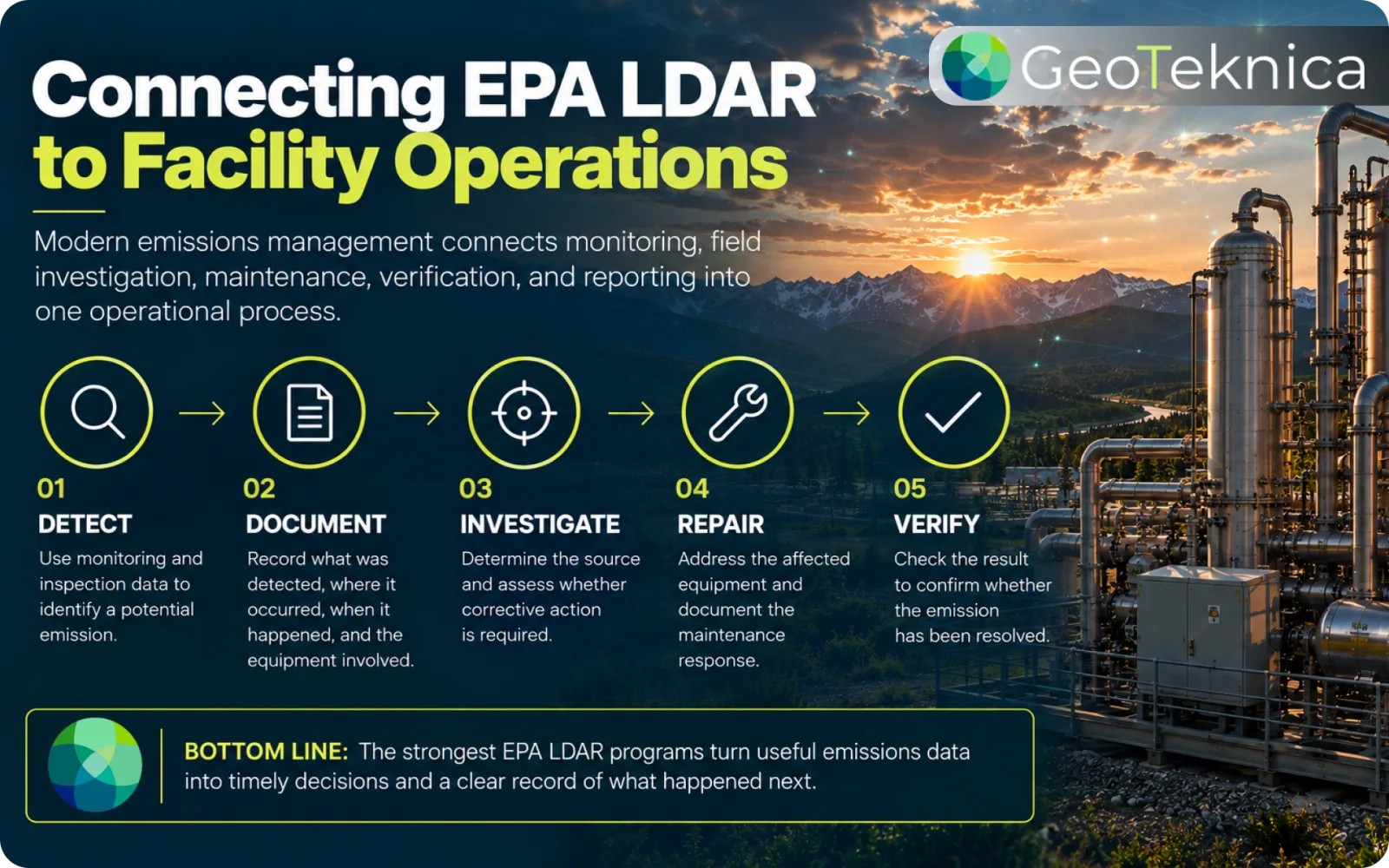
A useful EPA LDAR workflow can therefore be thought of as a series of connected steps: Detect. Document. Investigate. Repair. Verify. Each step produces information that can support the next.
A monitoring system may identify a potential emission. A technician can investigate the source and determine whether a repair is necessary. Maintenance personnel can address the issue, while follow up monitoring or inspection can confirm whether the emission has been resolved.
This approach can also improve accountability. Instead of having detection records sitting separately from maintenance records, operators can build a clearer history of what happened and when.
Verification Closes the Loop
Repair verification is an important part of a functioning EPA LDAR strategy. A repair is not necessarily the end of the story. Without verification, there is no clear confirmation that the emission has actually been reduced or eliminated.
Verification can take different forms depending on the equipment, monitoring approach, and applicable regulatory requirements. The important point is that the process should provide a reliable way to determine whether the original issue has been resolved, creating a feedback loop.
A facility detects a potential emission, investigates it, performs a repair, and then checks the result. If the emission remains, additional action may be required. If it has been resolved, the facility has a documented record of the response.
Over time, these records can also provide useful operational information. Recurring leaks may point to equipment that requires more frequent maintenance, components that are prone to failure, or areas of a facility where additional monitoring could be useful.
What This Means for Facility Teams
For operators, the practical impact of EPA LDAR is not limited to environmental compliance personnel. Field technicians may need to incorporate additional monitoring and documentation into their regular work. Maintenance teams may need to respond to emission related work orders. Environmental personnel may need to manage larger and more detailed datasets. Operations teams may need to coordinate these activities so that detection and repair do not happen in isolation.
A useful emissions management system should make it possible to understand what was detected, where it occurred, what action was taken, then what happened afterward. The value is not simply having more data, It is having data that can be accessed, understood, and acted upon.
For example, if a facility identifies repeated emissions from the same type of component, that information can potentially inform maintenance planning. If certain operating conditions consistently correspond with higher emissions, operators may be able to investigate those conditions more closely.
EPA LDAR requirements can, and should, become part of a broader effort to improve facility visibility and operational decision making.
Building an EPA LDAR Strategy for the Long Term
There is no single technology or inspection method that solves every emissions monitoring challenge. Different facilities have different equipment, layouts, operating conditions, and regulatory requirements. A more effective strategy is therefore likely to combine complementary approaches.
Periodic inspections can provide detailed information about equipment and components. Continuous monitoring can provide greater visibility between inspections. Maintenance systems can track repairs, while verification activities can confirm whether those repairs worked.
This also relies on considering how monitoring technologies fit into existing facility workflows. A system that generates information without a clear process for reviewing and responding to that information can quickly become difficult to manage.
The strongest EPA LDAR programs are not necessarily those that collect the most data. They are the ones that turn useful data into timely decisions.
A Regulatory Framework That Continues to Evolve
The regulatory environment surrounding methane emissions is continuing to develop. EPA has made changes to both reporting requirements and emissions standards, while additional regulatory actions and reconsiderations continue to shape how operators interpret and implement these requirements.
In April 2026, EPA finalized targeted changes affecting certain requirements under the oil and natural gas New Source Performance Standards, including provisions related to temporary flaring and monitoring of vent gas from certain combustion devices (EPA, 2026). For operators, this reinforces an important point: regulatory compliance cannot always be treated as a one time implementation project.
Requirements can change, reporting methodologies can evolve, and monitoring expectations can become more detailed. Facility teams need processes that can adapt without requiring their entire emissions management system to be rebuilt every time a regulatory update occurs.
From Compliance to Better Facility Visibility
The evolution of EPA LDAR reflects a broader shift in how methane emissions are managed. The goal is not simply to conduct an inspection, complete a form, and move on to the next reporting period. Effective emissions management increasingly depends on understanding what is happening across a facility and being able to respond when conditions change.
Subpart W emphasizes the importance of accurate emissions quantification and reporting. OOOOb establishes requirements intended to reduce emissions from covered sources. Together, they create an environment where detection, documentation, repair, and verification need to work together. For facility operators, that means EPA LDAR is becoming increasingly connected to everyday operations.
The opportunity is to build systems that do more than satisfy a regulatory requirement. When emissions data is timely, reliable, and connected to field action, it can provide a clearer picture of facility performance and help teams respond to problems before they become larger operational or environmental issues.
Methane management ultimately comes down to visibility and action. The better a facility can understand what is happening, the better positioned its teams are to decide what needs to happen next.
References
U.S. Environmental Protection Agency. (2024a). Final rule: Revisions and confidentiality determinations for petroleum and natural gas systems.
https://www.epa.gov/ghgreporting/subpart-w-rulemaking-resources
U.S. Environmental Protection Agency. (2024b). EPA’s final rule to reduce methane and other harmful pollution from oil and natural gas operations and related actions.
https://www.epa.gov/controlling-air-pollution-oil-and-natural-gas-operations/epas-final-rule-reduce-methane-and-other
U.S. Environmental Protection Agency. (2024c). Small entity compliance guide for oil and natural gas sector: Emission standards for new, reconstructed, and modified sources, 40 CFR Part 60, Subpart OOOOb.
https://www.epa.gov/system/files/documents/2024-05/final-nsps-oooob-secg_20240517_v2.0-508_1.pdf
U.S. Environmental Protection Agency. (2024d). Subpart W rule fact sheet.
https://www.epa.gov/system/files/documents/2024-05/subpart-w-rule-fact-sheet.pdf
U.S. Environmental Protection Agency. (2026). 2026 final rule to reduce burden on the oil and natural gas industry.
https://www.epa.gov/controlling-air-pollution-oil-and-natural-gas-operations/2026-final-rule-reduce-burden-oil-and
EPA LDAR and the New Methane Rules: What Subpart W and OOOOb Mean for Facility Operations