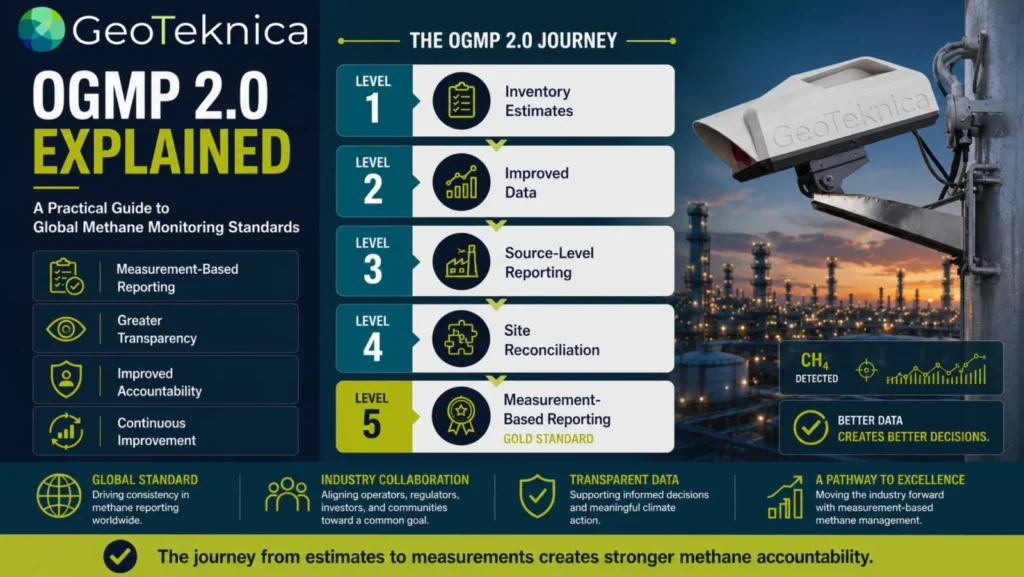
How Continuous Methane Monitoring Improves Emissions Management
Methane management has become an increasingly important part of modern oil and gas operations. For producers, the challenge is not simply identifying whether methane emissions exist. It is understanding where emissions are occurring, how often they occur, how significant they are, and what can be done about them.
That is where continuous methane monitoring can make a meaningful difference.
Traditional inspection programs remain an important part of emissions management, but they provide only a snapshot of conditions at a particular point in time. Continuous methane monitoring adds another layer of visibility by allowing operators to observe emissions more frequently and respond to changes as they happen.
At the same time, no single technology can capture every emission event. Fixed sensors, satellites, drones, aircraft, and other monitoring technologies each have different strengths. Used together, they can provide a more complete understanding of methane emissions across an operation.
From Periodic Inspections to Continuous Visibility
For decades, many oil and gas facilities have relied on periodic inspections to identify leaks and other sources of methane emissions. These inspections can be effective, but they are inherently limited by their frequency.
A leak that begins shortly after an inspection may remain undetected until the next scheduled survey. An intermittent emission may also occur between inspections and never be observed during a conventional survey.
Continuous methane monitoring changes that dynamic.
Fixed sensors can be positioned around facilities or near equipment where methane releases are more likely to occur. These systems can provide frequent measurements and, depending on the technology and configuration, can alert operators when methane concentrations exceed predetermined thresholds.
The U.S. Environmental Protection Agency recognizes continuous monitoring systems as one of the advanced technologies that can be used to detect methane emissions from oil and natural gas operations. EPA’s current alternative technology program includes continuous monitors alongside satellite monitoring, aerial surveys, and other advanced detection methods (U.S. Environmental Protection Agency [EPA], 2026a).
The value is relatively straightforward. Instead of asking what was happening when an inspector arrived, operators can gain a better understanding of what is happening over time.
Fixed Sensors: Watching What Happens on Site
Fixed sensors are one of the most direct forms of continuous methane monitoring.
Installed at strategic locations throughout a facility, these sensors can continuously or frequently measure methane concentrations. Depending on the system, measurements can be combined with information such as wind speed and direction to help operators determine whether an elevated reading may be associated with a particular source.
This can be especially useful at facilities with equipment that operates continuously or where certain components present a higher potential for methane releases.
Fixed monitoring also has an important role in identifying events that may not be captured through periodic inspections. Research reviewed by the IEA found that continuous monitoring at hundreds of oil and gas facilities detected a large share of estimated methane emissions occurring at relatively low emission rates, while larger super emitter events represented a smaller share of total emissions over the study period (International Energy Agency [IEA], 2026).
That finding highlights an important point. Finding the biggest leaks is valuable, but understanding the accumulation of smaller and more frequent emissions matters too.
Satellites: Seeing the Bigger Picture
If fixed sensors provide detailed information at a facility, satellites can provide a much broader view.
Satellite based methane detection has developed rapidly and can identify significant methane emission sources across large geographic areas. This makes satellite data particularly useful for regional screening and identifying large emission events that may warrant further investigation.
EPA has incorporated satellite detection and other remote sensing technologies into its advanced methane detection framework. The agency’s Super Emitter Program also allows certified third parties to use approved remote sensing technologies, including satellites and aircraft, to identify potential large methane releases (EPA, 2026b).
Satellite monitoring does have limitations. Detection capability can depend on the size of an emission, atmospheric conditions, geographic location, and the capabilities of the satellite being used.
For that reason, satellite data is most powerful when it is treated as one part of a broader monitoring strategy rather than as a replacement for facility level measurement.
A satellite may identify where to look. Continuous methane monitoring can help determine what happens at that location over time.
Drones: Bringing Monitoring Closer to the Source
Drones occupy an interesting middle ground between fixed sensors and satellite monitoring.
They can cover areas that are difficult or time consuming to inspect on foot while operating much closer to the equipment than a satellite. Depending on the technology being used, drones can carry optical gas imaging cameras or other sensors capable of detecting methane.
This can make drones particularly useful for targeted inspections, difficult to access equipment, and follow up investigations.
EPA’s current guidance confirms that drone based optical gas imaging can be used to meet certain standard OGI survey requirements when applicable requirements are satisfied, including appropriate training and inspection procedures (EPA, 2026c).
Drones can therefore complement continuous methane monitoring by helping operators investigate an alert or survey a specific area in greater detail.
Why Combining Technologies Matters
One of the biggest misconceptions about methane monitoring is that there needs to be a single technology that does everything.
In practice, the technologies work best when their strengths are combined.
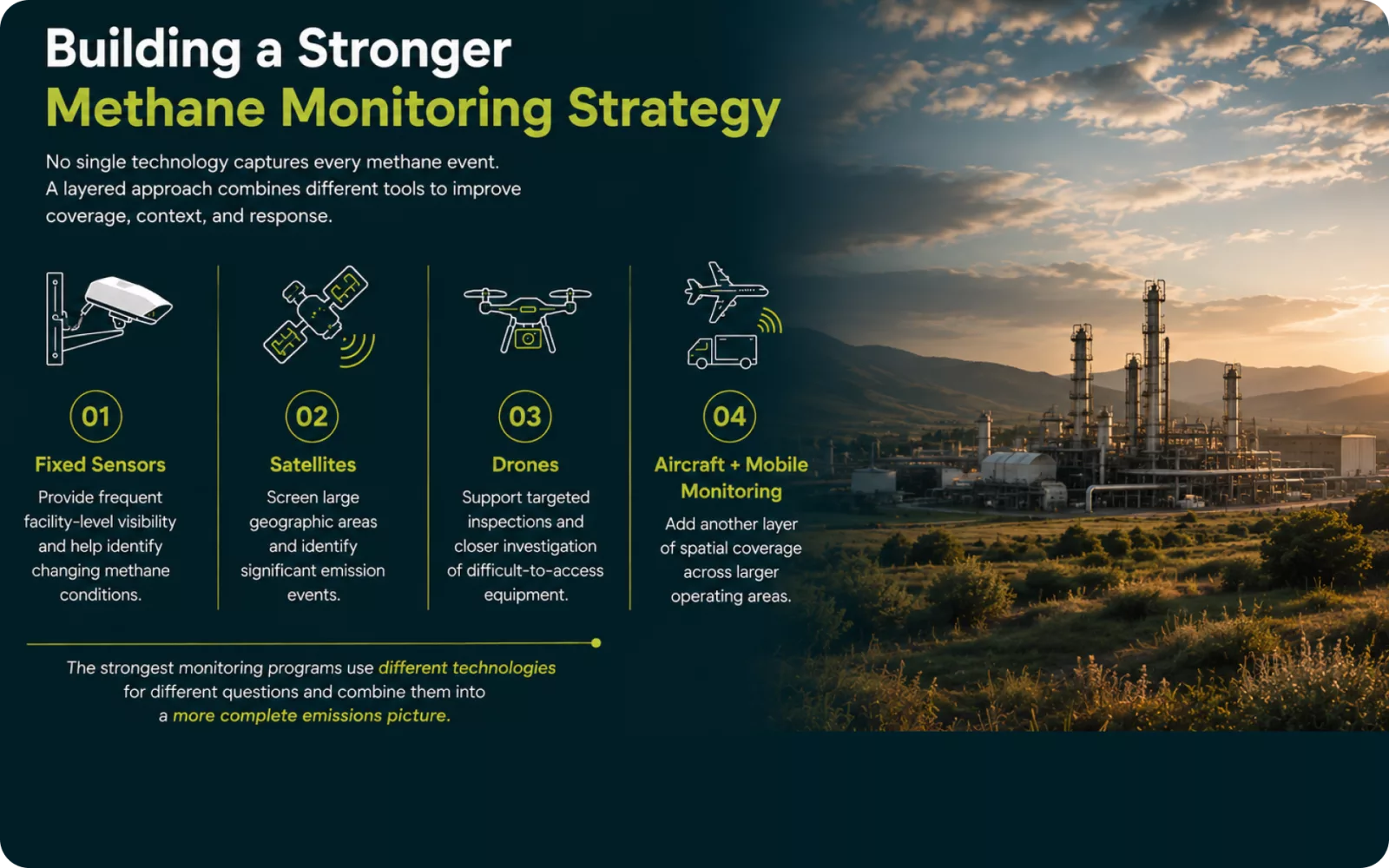
Fixed sensors can provide frequent facility level information. Satellites can identify significant emissions across large geographic areas. Drones can investigate specific locations and equipment. Aircraft and mobile monitoring platforms can provide another layer of spatial coverage.
The IEA’s 2026 analysis emphasizes this point. Research comparing satellite, airborne, drone, and ground based technologies has found meaningful differences in detection performance depending on the emission rate, operating conditions, and technology being used. The IEA concludes that combining orbital, airborne, and ground based measurements can improve both the spatial and temporal understanding of methane emissions (IEA, 2026).
In other words, continuous methane monitoring does not have to exist in isolation.
A strong monitoring program can use different technologies for different questions.
Turning Detection Into Action
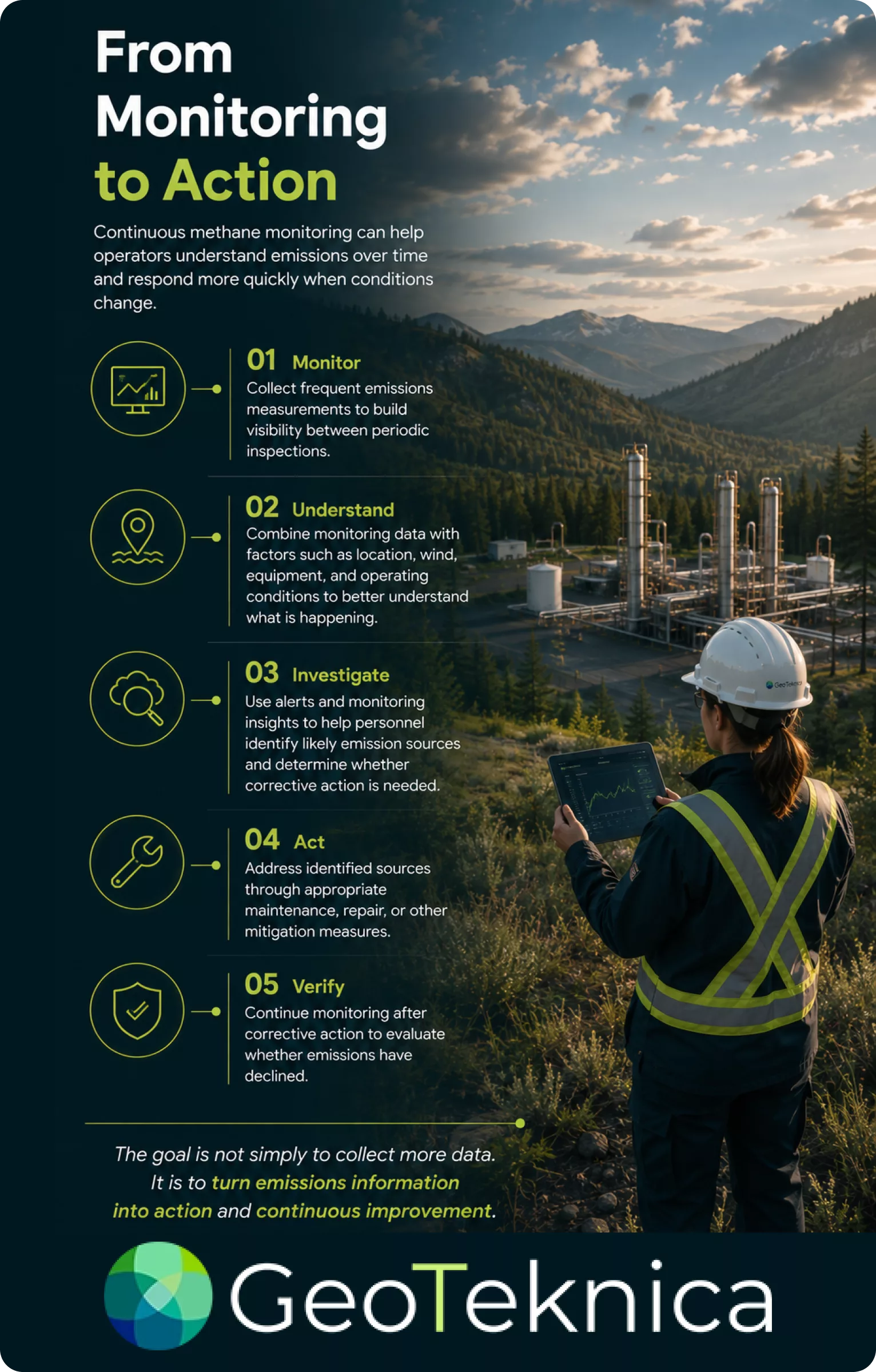
Detection is only the beginning.
The real value of continuous methane monitoring comes from what happens after an emission is identified. An effective system can alert the appropriate personnel, help identify the likely source, support an investigation, and provide information that can be used to determine whether corrective action is required. This can shorten the time between an emission beginning and an operator becoming aware of it.
That matters from both an environmental and operational perspective. Methane that escapes from equipment can represent an environmental impact, but it can also represent the loss of a valuable product. Identifying and addressing leaks can therefore support emissions management while potentially improving resource efficiency.
Continuous methane monitoring can also help organizations evaluate whether mitigation measures are working. If emissions decline after equipment is repaired or replaced, ongoing measurements can provide evidence of that change. The result is a shift from simply finding problems to learning from them.
Building Better Emissions Data
Another advantage of continuous methane monitoring is the quality and frequency of the information it can generate.
Periodic inspections can provide valuable observations, but they do not necessarily capture what happened between inspections. More frequent monitoring can create a much richer record of emissions behavior.
That information can support maintenance decisions, emissions inventories, regulatory reporting, and broader environmental management.
EPA has recognized the potential of advanced measurement technologies to improve the empirical information available for oil and gas emissions reporting. Its review of advanced measurement approaches includes stationary, aerial, drone, vehicle, and satellite platforms and recognizes that different technologies have different capabilities and limitations (EPA, 2024).
Better data does not automatically mean better decisions. The data still needs to be properly managed, interpreted, and connected to operational processes.
But when good data is paired with the right people and processes, it can give operators a clearer picture of where improvements are possible.
What Does an Effective Monitoring Strategy Look Like?
There is no universal monitoring configuration that will work for every facility.
The right approach depends on the size and design of the operation, the equipment present, the surrounding environment, the potential sources of emissions, and the objectives of the monitoring program.
For some facilities, fixed sensors may form the foundation of continuous methane monitoring. For others, periodic drone surveys or satellite screening may provide greater value. Many operations will benefit from a combination of approaches.
The important thing is to start with the question the monitoring program needs to answer.
Are you trying to detect leaks as quickly as possible?
Are you trying to identify large emission events?
Are you trying to understand long term emissions trends?
Are you trying to improve the accuracy of an emissions inventory?
The answer can help determine which technologies should be used and how they should work together.
The Future of Methane Management
Methane monitoring is becoming more sophisticated, but the underlying objective remains simple: understand what is happening and act when action is needed.
Continuous methane monitoring gives operators a way to move beyond periodic snapshots toward a more complete understanding of emissions over time. Satellites can expand the view beyond individual facilities. Drones can provide targeted inspection capabilities. Fixed sensors can provide frequent information from the operation itself.
Used together, these technologies can help turn methane management into a more proactive process.
For the oil and gas industry, that means better visibility into operations, better information for decision making, and more opportunities to identify practical ways to reduce emissions and improve efficiency.
The goal is not simply to collect more data. It is to create a monitoring system that turns data into action. That is where continuous methane monitoring can make its greatest contribution.
References
International Energy Agency. (2026). Global methane tracker 2026: Recent insights from methane emissions studies. IEA.
https://www.iea.org/reports/global-methane-tracker-2026/recent-insights-from-methane-emissions-studies-2
U.S. Environmental Protection Agency. (2024). Use of advanced and emerging technologies for quantification of annual facility methane emissions under the Greenhouse Gas Reporting Program.
https://www.epa.gov/system/files/documents/2024-08/ghgrp_rfi_2024.pdf
U.S. Environmental Protection Agency. (2026a). Oil and gas alternative test methods.
https://www.epa.gov/emc/oil-and-gas-alternative-test-methods
U.S. Environmental Protection Agency. (2026b). Methane Super Emitter Program.
https://www.epa.gov/compliance/methane-super-emitter-program
U.S. Environmental Protection Agency. (2026c). Frequently asked questions: Alternative technology.
https://www.epa.gov/controlling-air-pollution-oil-and-natural-gas-operations/frequently-asked-questions-alternative