British Columbia’s New Continuous Monitoring Mandate: A 2025 to 2030 Compliance Timeline
In British Columbia, managing methane is increasingly becoming a dynamic and data-focused aspect of oil and gas activities.
For producers and facility operators, recent regulatory changes mean that understanding where methane can be released is no longer enough. Operators increasingly need to know how much is being released, how quickly an issue can be identified and what steps are being taken to address it.
This is where BC’s methane monitoring requirements are becoming increasingly important.
The changes introduced by the British Columbia Energy Regulator (BCER) are part of a broader provincial effort to reduce methane emissions from the upstream oil and gas sector. B.C. has set a target of reducing oil and gas methane emissions by 75 per cent from 2014 levels by 2030, with a longer term objective of near elimination of industrial methane emissions by 2035. According to the BCER, B.C. achieved a 51 per cent reduction in oil and gas methane emissions by 2023, exceeding its interim 45 per cent reduction target two years ahead of schedule (British Columbia Energy Regulator [BCER], 2026). The result of this initiative is a regulatory environment that is placing greater emphasis on measurement, early detection, and practical emissions reduction.
What is changing?
It is worth clarifying what the term “continuous monitoring” means in the context of B.C.’s regulations. The province has not introduced a requirement for every oil and gas facility to continuously monitor every potential methane source. Instead, the regulatory approach is targeted toward equipment and facilities where the potential for emissions is greater.
The amendments that came into effect January 1, 2025 require automated monitoring systems on equipment identified as having the highest rates of leakage. They also increased the number of leak detection and repair surveys required at large facilities, tightened venting requirements for certain operations, and introduce additional design and operating standards for new and modified facilities (BCER, 2024).
The objective is not simply to add more technology to a facility, It is to improve the ability to identify meaningful emissions and respond to them before they become a larger or longer lasting problem. For operators, BC’s methane monitoring is therefore becoming part of a larger system that connects monitoring, maintenance, reporting and emissions reduction.
The compliance timeline
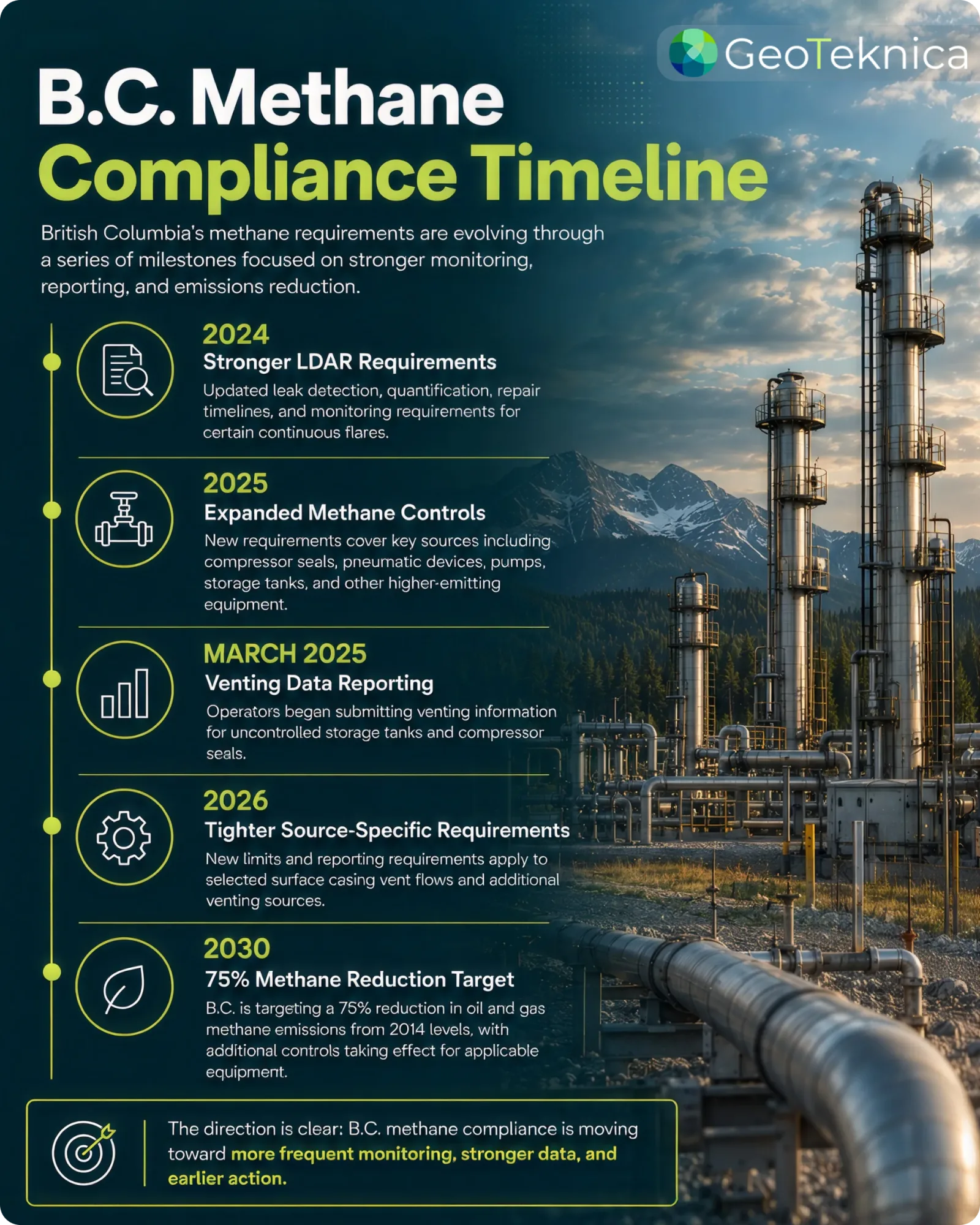
The regulatory changes are best understood as a series of milestones rather than a single compliance deadline.
January 1, 2024: Stronger monitoring and leak detection requirements
The first major update took effect in 2024. The changes included updates to Leak Detection and Repair, commonly known as LDAR, including revised survey requirements, leak quantification, and repair timelines. The amendments also introduced requirements for continuous monitoring or frequent inspections of certain unsupervised continuous flares (BCER, 2023).
This was an important step toward more frequent and targeted emissions detection. Rather than relying exclusively on periodic inspections, operators began moving toward monitoring approaches that better reflect the potential risk associated with particular equipment and operating conditions.
January 1, 2025: Expanded methane requirements
The next major phase began January 1, 2025. The updated regulations expanded requirements covering several important methane sources, including compressor seals, pneumatic devices and pumps, glycol dehydrators, storage tanks, surface casing vent flows and equipment subject to LDAR requirements (BCER, 2024).
The amendments also introduced automated monitoring requirements for equipment with the highest leakage rates. For operators, this means BC’s methane monitoring increasingly requires a combination of technologies and operating practices rather than a single monitoring method. The appropriate approach will depend on the facility, equipment and source being monitored.
March 31, 2025: First venting data submissions
The regulatory changes also placed greater emphasis on documenting emissions. For the 2024 reporting year, operators were required to submit venting information for uncontrolled storage tanks and compressor seals by March 31, 2025. The BCER introduced an updated template to support the tracking and submission of this information (BCER, 2025a).
The importance of this requirement extends beyond paperwork. Reliable emissions data can help operators identify recurring problems, understand which equipment represents the greatest opportunity for improvement and make better decisions about where maintenance or technology investments should be directed.
January 1, 2026: Surface casing vent requirements
Another important milestone arrived in January 2026. Requirements for certain surface casing vent flows became more stringent, including a maximum emissions rate of 3 cubic metres per day for specified wells. The BCER also introduced a notification process for operators undertaking measures to control affected surface casing vent emissions (BCER, 2026b). This illustrates how the regulatory framework is continuing to move from broad emissions reduction objectives toward specific requirements for individual emissions sources.
March 31, 2026: Expanded venting reporting
March 31, 2026 marked another reporting milestone. Operators were required to submit venting information for pneumatic devices and pneumatic pumps covering the 2025 reporting year. The BCER has also updated its submission processes for LDAR information and venting data to improve consistency and regulatory oversight (BCER, 2025b). This continued emphasis on reporting reinforces a central theme of BC’s methane monitoring: what gets measured can be better understood, managed and reduced.
2030: The next major target
The province’s broader objective is a 75 per cent reduction in oil and gas methane emissions compared with 2014 levels by 2030. The 2025 regulatory amendments are designed to contribute to that target, including through additional controls on pneumatic devices and pumps. The regulations establish an annual methane emissions threshold for applicable pneumatic device and pump fleets beginning January 1, 2030 (BCER, 2024).
The timeline therefore extends well beyond the initial implementation of automated monitoring. The direction is clear and methane management is becoming an ongoing, essential component of facility operations.
Why continuous monitoring matters
Methane presents a particular monitoring challenge because it is colourless and odourless at typical concentrations. Leaks can occur from valves, seals, connectors, pneumatic equipment, tanks and other components, sometimes without any obvious indication that something is wrong. Traditional inspection programs remain valuable, but they provide a snapshot of conditions at a particular moment.
Continuous or automated monitoring can provide something different. Instead of discovering an issue during the next scheduled inspection, a monitoring system may identify a change in conditions much sooner. That can allow an operator to investigate the source, determine whether maintenance is required and potentially reduce the duration of the emission. This is one of the practical benefits of BC’s methane monitoring requirements.
The value is not simply in collecting more data. It is in collecting useful data at the right time and turning that information into action. The BCER itself describes leak detection and repair, gas capture and combustion improvements as important tools for reducing methane emissions from energy operations (BCER, 2026a).
Technology is part of the solution
There is no single technology that will be appropriate for every facility. Depending on the application, operators may use fixed continuous sensors, optical gas imaging, aerial surveys, handheld instruments or other measurement technologies. Some approaches are designed to provide continuous information, while others are better suited to periodic surveys or targeted investigations. That flexibility is important because B.C.’s oil and gas infrastructure includes a wide range of facilities and operating environments.
A large processing facility may have very different monitoring needs from a remote wellsite. Equipment with a history of higher emissions may justify more frequent or automated monitoring, while other sources may be effectively managed through scheduled inspection and maintenance. The goal should be to match the monitoring approach to the risk. In that sense, BC’s methane monitoring framework is not simply about installing sensors. It is about creating a more complete picture of where emissions are occurring and where intervention can make the greatest difference.
Turning compliance data into operational value
There is also an opportunity for operators to look beyond compliance. Methane that escapes from equipment represents an emissions issue, but it can also represent lost product. Identifying and repairing a leak can therefore have both environmental and operational benefits. Better monitoring can also help maintenance teams identify recurring equipment problems.
If the same type of valve, seal or pneumatic device repeatedly produces emissions, that information can inform future equipment selection and maintenance planning. Over time, data can help companies move from reacting to individual leaks toward identifying patterns and preventing problems. This is how BC’s methane monitoring requirements can become more than a regulatory obligation. When emissions data is integrated into maintenance and operational decision making, it can become another tool for improving facility performance.
What operators should be considering now
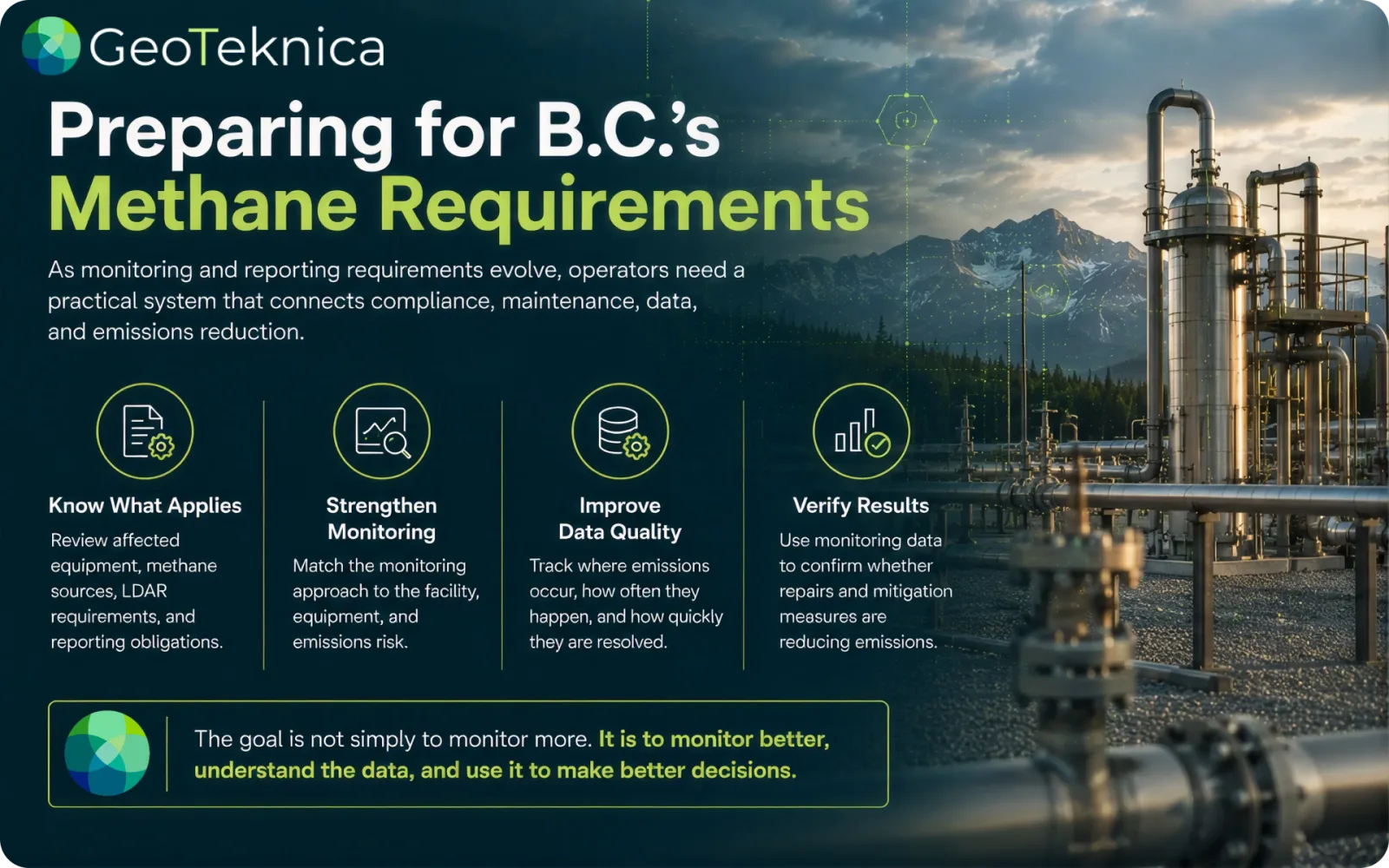
For operators, the immediate priority should be understanding which requirements apply to their facilities and equipment. That means reviewing applicable methane sources, confirming monitoring and LDAR requirements, checking data collection processes and ensuring that reporting responsibilities are clearly understood.
It’s worth considering whether existing monitoring systems provide enough information to support timely decision making. A strong compliance program should do more than document whether a required inspection was completed. It should provide a clear view of where emissions are occurring, how often they occur, how quickly they are detected and how long they remain unresolved.
Operators should also assess whether repairs and other mitigation measures are producing measurable reductions. This information can help maintenance and environmental teams identify recurring issues, prioritize corrective action and improve the effectiveness of their monitoring programs.
These considerations are increasingly relevant as BC’s methane monitoring requirements continue to evolve.
Looking beyond the next deadline
B.C.’s approach to methane reduction also exists within a broader Canadian regulatory framework. In 2025, the federal government and B.C. entered into a new equivalency agreement concerning methane emissions from the upstream oil and gas sector. Under the agreement, B.C.’s provincial methane regulations are recognized as providing equivalent outcomes to the federal requirements, allowing the federal methane regulations to be stood down in the province. The agreement came into force in February 2025 and is scheduled to expire in February 2030, subject to its terms and ongoing review (Environment and Climate Change Canada, 2025).
The relationship between provincial and federal requirements is important for operators to understand because regulatory equivalency does not mean the regulatory landscape is static. The agreement provides for ongoing review, including consideration of future federal regulatory amendments. The landscape is always changing making adaptability an essential aspect of planning.
For companies operating in B.C., the most effective approach may not be to treat each regulatory change as a separate requirement. Instead, monitoring, measurement, maintenance, reporting and emissions reduction can be viewed as connected parts of the same operational process.
A practical path forward
The evolution of BC’s methane monitoring requirements reflects a broader shift in how methane emissions are managed. The focus is moving toward better information, earlier detection and more targeted action. For industry, that means compliance programs will increasingly need to combine regulatory knowledge with practical field implementation and appropriate technology. The environmental objective is straightforward: reduce unnecessary methane emissions.
For operators, there can be practical benefits as well. Better visibility can mean earlier identification of equipment problems, reduced product loss and more informed maintenance decisions. With the 2030 target approaching, the companies that build effective monitoring and emissions management into everyday operations will be better positioned to meet the requirements ahead. The next few years will not simply be about monitoring more. They will be about monitoring better, understanding the data and using it to make better decisions.
References
British Columbia Energy Regulator. (2023, April 4). Updates to methane emissions requirements (IU 2023 07). BC Energy Regulator. BC Energy Regulator: Updates to Methane Emissions Requirements
British Columbia Energy Regulator. (2024, September 9). New regulatory amendments to reduce methane emissions (IU 2024 11). BC Energy Regulator. BC Energy Regulator: New Regulatory Amendments to Reduce Methane Emissions
British Columbia Energy Regulator. (2025a, January 10). Updated template for tracking and submission of venting information (TU 2025 01). BC Energy Regulator. BC Energy Regulator: Technical and Information Updates
British Columbia Energy Regulator. (2025b, December 8). Methane emission submission updates for permit holders (TU 2025 20). BC Energy Regulator. BC Energy Regulator: Methane Emission Submission Updates
British Columbia Energy Regulator. (2026a). Methane emissions. BC Energy Regulator. BC Energy Regulator: Methane Emissions
British Columbia Energy Regulator. (2026b). New surface casing vent emission control notification to support methane reduction regulations. BC Energy Regulator. BC Energy Regulator: Surface Casing Vent Emission Control Notification
Environment and Climate Change Canada. (2025, March 13). Canada British Columbia equivalency agreement respecting the release of methane from the oil and gas sector. Government of Canada. Government of Canada: Canada British Columbia Methane Equivalency Agreement
British Columbia’s New Continuous Monitoring Mandate: A 2025 to 2030 Compliance Timeline, An article discussing BC’s methane monitoring practices.